

I. Asian Early Session Fluctuations
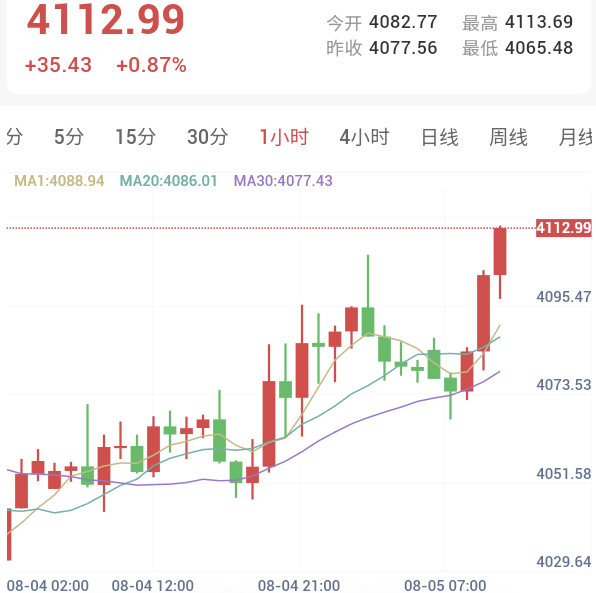
On August 4, benchmark energy prices plunged by over 5%, while spot gold advanced 0.5% to near 4,077.21 USD per ounce, hitting an intraday peak of 4,106.24 USD. August gold futures closed up 1.5% at 4,152.60 USD, as market pricing for a September Federal Reserve rate hike dropped from 68% to 59%, accompanied by a decline in US Treasury yields.
In the early Asian session on August 5, spot gold continued its ascent, trading near 4,112.99 USD per ounce as market focus shifted toward upcoming ADP private payrolls and July non-farm payrolls data.
II. Energy Contract Reallocations and Geopolitical Dynamics

On August 4, benchmark energy futures slumped over 5%, touching nearly 3-week lows. Qatari and US officials released positive signals, with Qatar stating that mediators have achieved progress in facilitating de-escalation, while US officials confirmed ongoing discussions regarding the reopening of the Strait of Hormuz. The Strait of Hormuz handles roughly one-fifth of global liquefied natural gas and oil shipments, making maritime security there a key regional priority.
In tandem with these market moves, Bart Melek, Head of Global Commodity Strategy at TD Securities, noted that price adjustments across energy markets serve as a core fundamental backdrop for the broader commodities segment. On the same day, the US Dollar Index closed slightly lower by 0.1% at 99.85 points.
III. Diplomatic Negotiation Progress and Interest Rate Expectation Shifts

Following more than five months of US-Iran conflict, discussions regarding diplomatic resolutions have gained traction. The Qatari Amir's office revealed that US and Qatari representatives communicated to narrow differences and enhance the probability of reaching a workable framework. Iran indicated that discussions with Oman regarding maritime route adjustments in the Strait of Hormuz remain underway.
US Treasury markets adjusted accordingly. Rate-sensitive 2-year Treasury yields fell to 4.194%, marking a near 2-week low, while 10-year yields pulled back to 4.627%. CME FedWatch tool data indicated that market probability of a Fed rate hike at the September meeting recalibrated from 68% on August 3 down to 59%.
Under this macro backdrop, market participants maintain a cautious posture. Maritime navigation conditions and the subsequent evolution of regional geopolitics remain pivotal variables steering commodity and financial asset prices.
IV. Labor Market Data and Federal Reserve Policy Watch
Gold price dynamics continue to respond to US macroeconomic disclosures and Federal Reserve policy recalibrations. This week's core focus centers on labor market metrics, with ADP employment figures due on August 5 and the July non-farm payrolls report scheduled for August 7. Surveys indicate consensus expectations for July payroll additions of roughly 80,000 jobs, with the unemployment rate hovering around 4.2%.
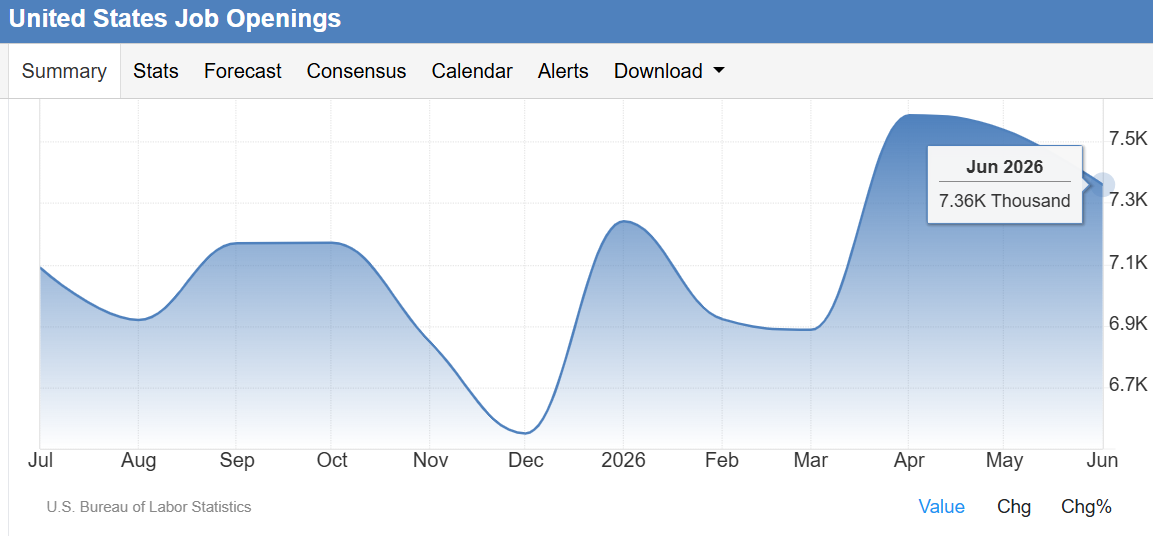
June JOLTS job openings data released on August 4 indicated moderating labor demand. Openings fell by 178,000 to 7.359 million, while hires rose slightly, layoff rates remained suppressed, and voluntary quits registered a modest uptick. Overall, the labor market exhibits a state of decelerating hiring alongside subdued layoff velocity.
On trade metrics, the June US trade deficit narrowed to 73.3 billion USD, driven primarily by lower capital goods imports. The Federal Reserve maintained its target benchmark rate at 3.50% to 3.75% during its previous meeting, which featured three dissenting votes favoring rate increases.
Market Outlook
In summary, gold market price action reflects the combined influences of energy price corrections, diplomatic negotiation updates, and shifts in Treasury yields.
Looking ahead, short-term gold prices will remain responsive to event developments and upcoming macroeconomic disclosures. Investors will closely track subsequent Fed policy trajectories, real yield variations, and US Dollar Index performance.