


I. Event Overview
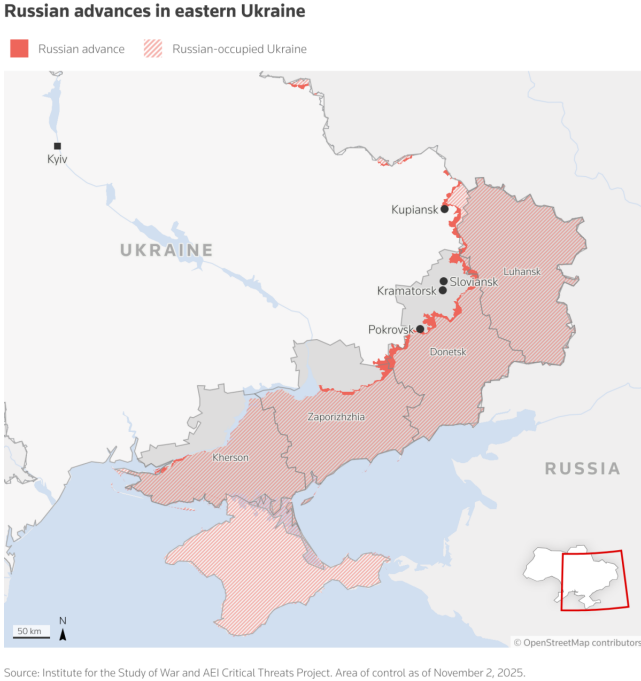
On November 3, 2025, Russian troops made progress in the city of Pokrovsk in eastern Ukraine. While Russia stated that its military had taken control of parts of the city, the Ukrainian military insisted that its defense lines remained solid and had not fully collapsed.
Pokrovsk is a crucial transportation and logistics hub in eastern Ukraine. For Russia, controlling the city means being able to advance toward Kramatorsk and Sloviansk—currently Ukraine’s largest and most strategically significant cities in the Donetsk region.
The escalation of this battle has further heightened market attention to geopolitical risks. The fight for Pokrovsk is not only about the tactical significance of the war but may also determine the future direction of the situation in the Donetsk region. As the fighting continues, market concerns about the global economy have increased, and demand for safe-haven assets such as gold may rise further.
II. Reactions from All Parties
Ukraine
The Ukrainian military stated that although Russia had made some progress around Pokrovsk, the battle was still ongoing, and the Ukrainian military’s defensive posture in the area remained unshaken.
Zelensky also revealed that the Ukrainian military had begun counterattacks in other areas outside Pokrovsk, aiming to distract Russia and reduce pressure on Pokrovsk.
Russia
Russia stated that control of Pokrovsk is crucial for future military operations. If the city can be fully occupied, Russia will be able to strategically approach Kramatorsk and Sloviansk, further consolidating its control over Donetsk.
III. Technical Analysis
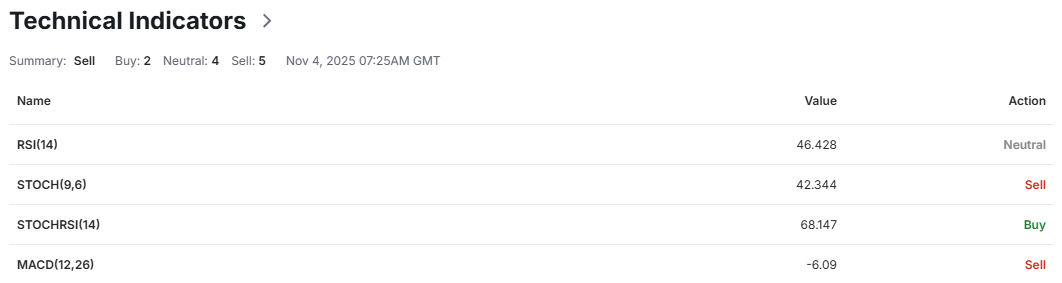
As of November 4, 2025, the spot gold price was quoted at $3,992.67 per ounce, showing a volatile downward trend. In the short term, the fluctuation range of gold prices is relatively small, and market sentiment is cautious.
- The RSI (14) value is 46.428, in the neutral zone, indicating balanced market sentiment and a lack of clear upward or downward momentum for gold prices in the short term.
- The STOCH (9,6) is 42.344, approaching the sell zone, suggesting that gold prices may face correction pressure.
- The STOCHRSI (14) is 68.147, close to the overbought zone, implying potential short-term correction.
- The MACD (12,26) is -6.09 (negative), indicating strong short-selling momentum in the market in the short term and downward pressure on gold prices.
Overall, gold prices may face downward risks in the short term. Although the market is close to the overbought zone, short-selling pressure still dominates, which may lead to a further decline in gold prices.
IV. Outlook
As the Russia-Ukraine conflict continues to escalate, especially with the intensifying battle in Pokrovsk, gold still receives long-term support. Demand for gold as a safe-haven asset may continue to be boosted, and gold prices still have upside potential in the short term, especially against the backdrop of deteriorating geopolitical conditions.
However, as technical indicators show that gold prices are close to the overbought zone, the market may also face short-term correction pressure.
Summary
Against the backdrop of escalating geopolitical risks, gold prices still have room for growth but may face short-term corrections. Investors should closely monitor changes in the global situation, particularly the development of the Russia-Ukraine conflict and its impact on market sentiment, while conducting operations based on technical signals to achieve optimal investment returns.