

Renewed Attacks on Infrastructure Reinforce Monetary Tightening Expectations

On Tuesday afternoon, despite diplomatic signals of moderation—such as Oman proposing a strait management framework and continued contacts between the US and Iran—severe threats facing physical supply chains remained unmitigated. Saudi Arabian authorities confirmed the interception of multiple drones targeting major energy infrastructure near Riyadh. Concurrently, Yemeni armed forces claimed responsibility for attacking Saudi Arabia's East-West pipeline leading to Red Sea ports.
This series of substantive strikes against critical node infrastructure reiterated to market participants that physical transmission bottlenecks for primary energy and refined fuels remain extremely fragile. The resilience of spot energy prices continues to transmit imported inflation pressure across macro frameworks.
Physical Supply Chain Bottlenecks Remain Unresolved: Although vessel traffic through the Bab-el-Mandeb Strait rebounded to 28 ships on Monday, attacks on Saudi Arabia's key East-West transmission pipeline indicate that overland alternative energy routes bypassing maritime chokepoints face severe disruption risks as well.
Global Central Bank Tightening Expectations Firmly Solidified: Within a macroeconomic framework where inflation stickiness refuses to dissipate rapidly, market pricing for the Federal Reserve, European Central Bank, and Bank of Japan to maintain higher interest rates for an extended period—or even execute further tightening in the second half of the year—has been firmly reinforced.
Against the backdrop of unwavering hawkish stances across major global central banks, sustained high Treasury yields and elevated borrowing costs continue to heighten the opportunity cost of holding non-yielding gold. Capital outflows accelerated under the weight of high interest rates, driving gold prices into a high-volume technical breakdown during afternoon trading.
Heavy Selling Pressure Drives Price Action Below Key Moving Averages
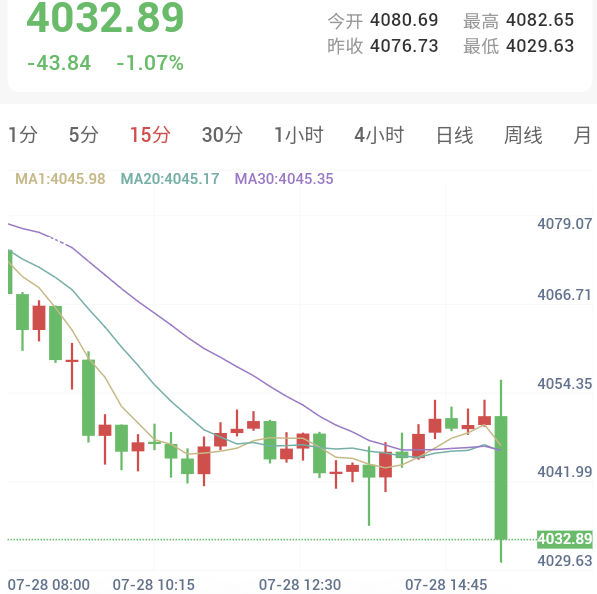
As of approximately 17:39 Beijing time on July 28, spot gold was trading at $4,032.89 per ounce, down 1.07% intraday and refreshing its intraday low to $4,029.63 per ounce.
Prior to 14:00 in the afternoon, price action engaged in moderate rangebound consolidation between $4,045 and $4,055. However, after 17:00, concentrated technical selling emerged. Candlesticks printed a massive red bar, slicing through multiple short-term defensive levels to hit a fresh intraday low at $4,029.63.
Moving Average Cluster Exerts Overhead Resistance: The MA1 ($4,046.12), MA20 ($4,045.24), and MA30 ($4,045.38) moving averages have converged tightly within the $4,045–$4,046 zone to form a dense overhead ceiling. As gold prices swiftly broke down on heavy volume late in the session, all three moving averages aligned above price action, constituting immediate dynamic overhead resistance.
15-Minute Technical Indicators Signal Strong Sell amid Oversold Divergence
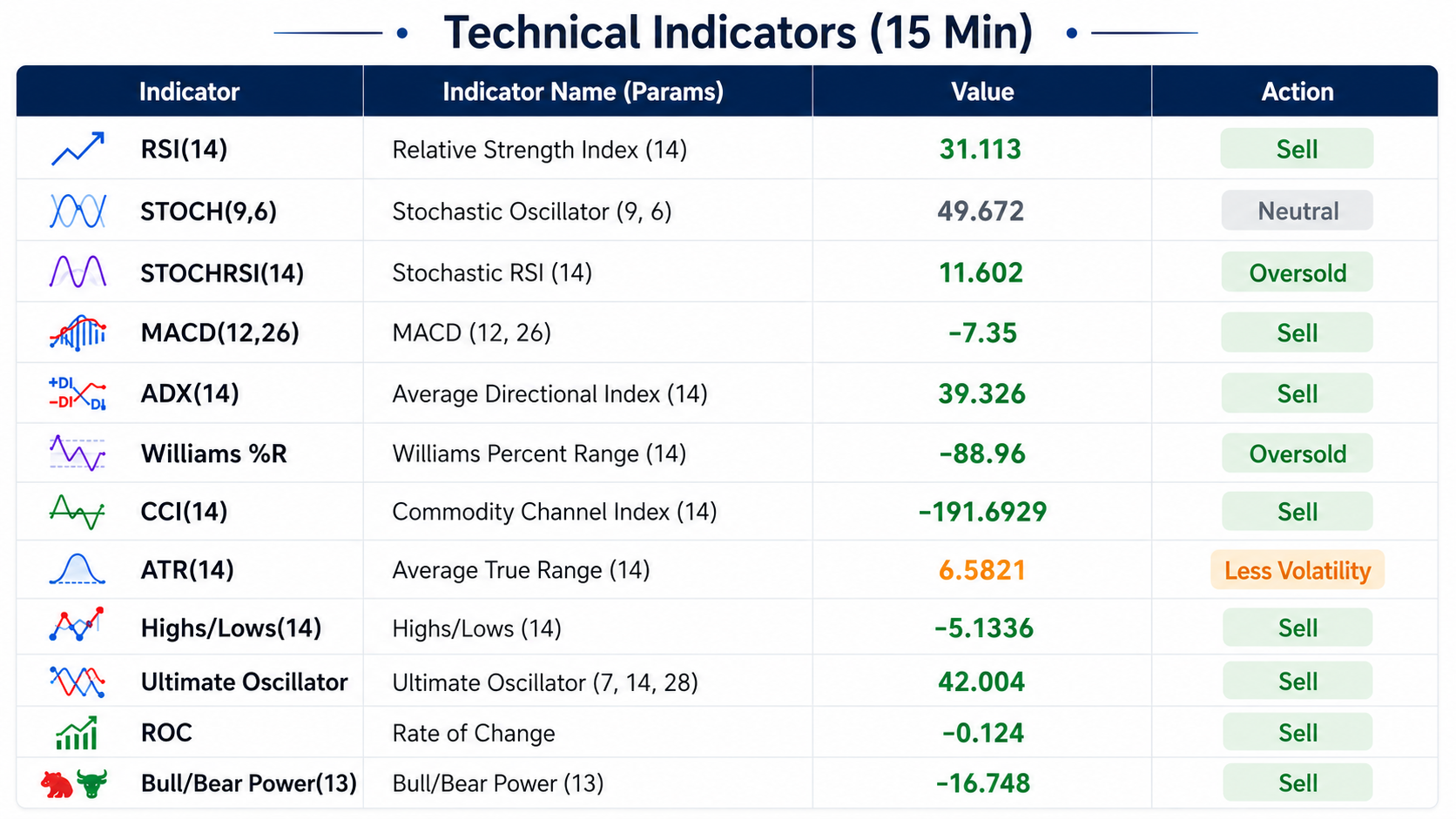
According to 15-minute technical indicator data as of 17:39, the steep vertical drop late in the session pushed overall technical ratings to a Strong Sell (0 bullish metrics, 1 neutral, 8 bearish), with short sellers maintaining firm dominance while sensitive oscillators entered extreme oversold territory.
Core Trend and Momentum Indicators Signal Deep Bearishness: The Relative Strength Index RSI(14) plummeted to 31.113, while the Commodity Channel Index CCI(14) registered -191.6929, pushing both deep into bearish territory. The medium-term MACD Level reads -7.35, and the Average Directional Index ADX(14) stands at 39.326, demonstrating strong trend continuity behind the short-term sell-off.
Sensitive Oscillators Enter Extreme Oversold Zone: The Stochastic RSI Fast printed 11.602, and the Williams Percent Range dropped to -88.96, plunging both into extreme oversold territory. This indicates that short-term selling pressure was largely absorbed following the breakdown below $4,035, creating technical demand for lower-level consolidation and position turnover.
Future Outlook for Gold
In summary, the gold market today faced systemic pressure from attacks on Saudi energy pipelines, drone interceptions near Riyadh, and solidified expectations of prolonged high central bank interest rates. On the macro level, physical energy transit bottlenecks maintain upward pressure on inflation and rate hike expectations. Technically, the MA1, MA20, and MA30 moving averages on the 15-minute chart converged between $4,045 and $4,046 to form dynamic overhead resistance as price action probed lower toward $4,033.59, exhibiting characteristics of a strong unilateral sell rating alongside extreme oversold Stochastic RSI readings.