

I. Eurozone Inflation Rebounds

On Friday afternoon, official data released by Eurostat revealed that Eurozone July Consumer Price Index (CPI) inflation accelerated from 2.8% in the previous month to 2.9% year-on-year, matching market consensus. Core CPI, which excludes food and volatile energy costs, accelerated from 2.4% to 2.5%, with services inflation rising to 3.3%. Concurrently, Eurozone second-quarter GDP expanded by a robust 0.4% quarter-on-quarter, doubling market forecasts and effectively dispelling fears that elevated borrowing costs might trigger an economic recession.
Rebounding inflation alongside resilient economic growth provides solid empirical backing for the European Central Bank (ECB) to pursue additional interest rate hikes at its September 10 policy meeting. Money markets have fully priced in further tightening by the ECB during the second half of the year. Against a macroeconomic backdrop of stubborn energy and supply chain costs and entrenched global monetary tightening expectations, the opportunity cost of holding non-yielding gold continues to escalate, maintaining persistent gravitational pressure on precious metals.
II. Stepped Breakdown and Overhead Moving Average Resistance
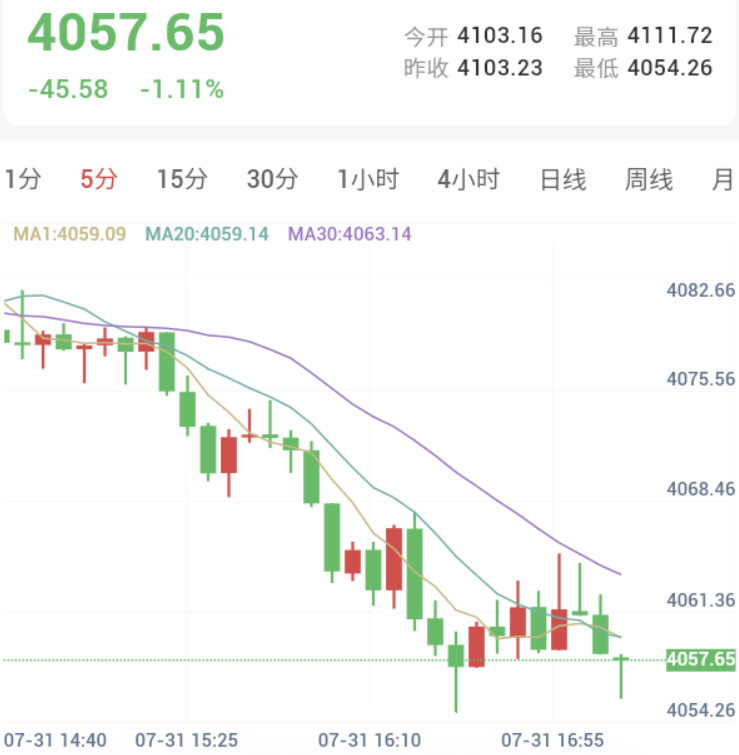
As of approximately 17:14 Beijing time on July 31, spot gold traded at $4,057.65 per ounce, down 1.11% on the day (a drop of $45.58). Prices drifted steadily downward from a session high of $4,111.72 per ounce during early trading, reaching a low near $4,054.26 per ounce.
Coinciding with the 17:00 release of Eurozone inflation data, concentrated breakdown selling pressure emerged across trading desks. Candlestick charts formed consecutive extended bearish bars, slicing through multiple intraday support levels at $4,070 and $4,060 before testing a new session low of $4,054.26 at around 17:10.
On the 5-minute chart, current MA1 ($4,059.09), MA20 ($4,059.14), and MA30 ($4,063.14) display a classic bearish downward fan-out configuration. Spot prices are consolidating weakly directly beneath the MA1 and MA20 moving averages, establishing a dynamic resistance band between $4,059 and $4,063 per ounce.
III. 30-Minute Technical Indicators Signal Strong Sell and Extreme Oversold Conditions
According to 30-minute technical indicator data at 17:14, following a swift sell-off exceeding $45 during the afternoon session, the overall technical rating stands at Strong Sell (0 Buy signals, 0 Neutral signals, 9 Sell signals). While short sellers maintain overwhelming control, sensitive oscillators have entered deeply oversold territory:
Core trend and momentum oscillators show widespread breakdowns:
RSI(14) plummeted to 40.408 in deep bearish territory,
STOCH(9,6) registered 25.74,
CCI(14) recorded -130.8226,
MACD Level registered -1.13,
ADX(14) trend strength reached 37.544 with an active Sell signal, and
Bull/Bear Power printed -31.8682.
The alignment across these indicators confirms strong short-term directional momentum.
Sensitive oscillators entered extreme oversold zones:
Stochastic RSI Fast printed 0.000, and
Williams Percent Range reached -96.39, both sinking into deeply oversold territory.
This suggests that short-term selling pressure reached an aggressive climax after breaking below $4,060, creating technical requirements for low-level consolidation and position turning.
Session Summary
Overall, today's gold market faced systemic pressure from a dissenting vote for a 1.25% rate hike at the Bank of Japan, hawkish stances from both the BOJ and Federal Reserve, and rebounding Eurozone July inflation at 2.9% which boosted expectations for a September ECB rate hike. Macroeconomically, persistent high global interest rates and sticky inflation expectations maintain heavy top-side pressure on holding non-yielding bullion.
Risk Warning
Trading markets carry inherent and unpredictable risks, including but not limited to the loss of principal. This analysis is provided for reference only and does not constitute direct investment advice. Investors should make independent judgments and autonomous decisions based on their risk tolerance.