

Warsh's Speech Reverberates as Market Focus Shifts to U.S. Non-Farm Payrolls
1. Gold Extends Decline, Touching Intraday Low of $4,418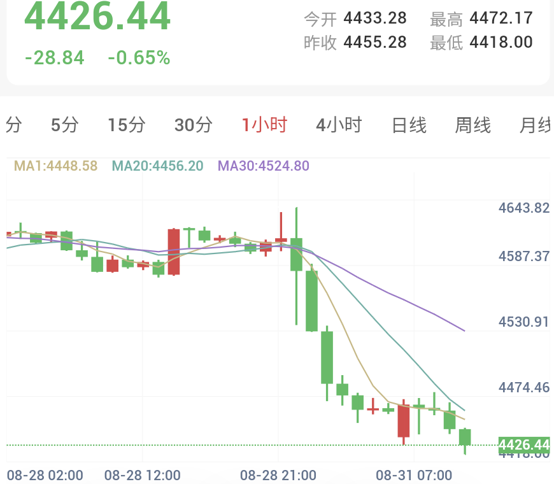
During the Asian session on August 31, spot gold extended the corrective trend that began last Friday. As of 10:25 Beijing time, gold traded at $4,426.44/oz, down $28.84 or 0.65% intraday. The session opened at $4,433.28, touched a high of $4,472.17, and tested a low of $4,418.00.
Gold experienced a sharp sell-off following the Jackson Hole Symposium last Friday, eventually closing near $4,455. Although it briefly rebounded above $4,470 in early Monday trading, the price subsequently retreated. The $4,420 level has emerged as a new short-term observation zone. On the 1-hour chart, gold has clearly broken below its short-term moving averages.
2. Warsh's Remarks Reprice September Policy Expectations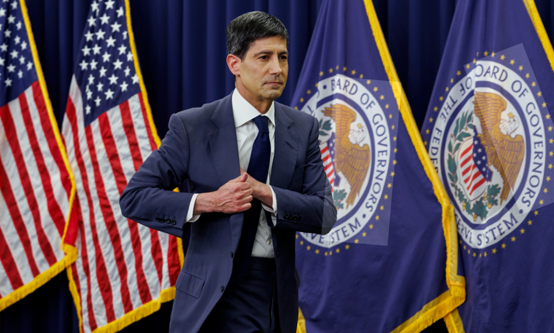
The primary catalyst for gold's rapid decline remains Fed Chair Warsh's inaugural major address at the Jackson Hole Symposium.
Warsh stated that policymakers still "have work to do" if the Fed cannot confirm that core inflation is clearly and rapidly returning to the 2% target. He also noted that the U.S. labor market remains stable, while July PCE held at 3.7% year-over-year, indicating that price pressures have not yet shown sufficient improvement.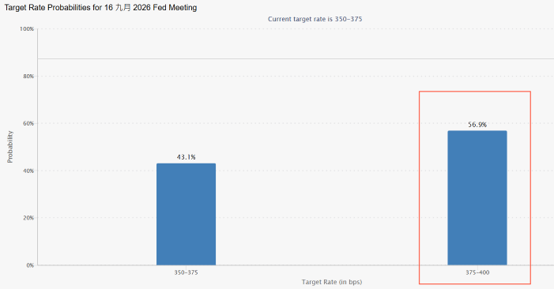
Following his speech, the market rapidly repriced its September meeting expectations. FedWatch data showed the probability of a further rate hike in September surged from approximately 36% to around 56.9%, with expectations for December also rising. Consequently, gold tumbled from above $4,600 and continued to drift toward $4,420 on Monday.
3. U.S. Treasury Yields Spike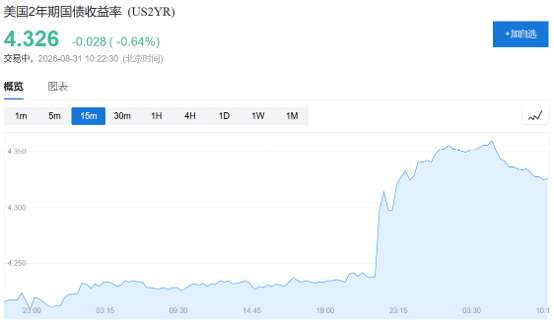
Following Warsh's speech, the U.S. Treasury market also saw significant shifts. The policy-sensitive 2-year Treasury yield jumped nearly 12 basis points on Friday, reaching a multi-week high, while the 10-year yield rose in tandem.
Concurrently, the U.S. dollar index surged by about 0.55% on Friday, recording one of its largest weekly gains in ten weeks.
Recently, the U.S. Treasury's expanded long-term bond buyback program temporarily drove long-term yields down. However, post-Jackson Hole, market focus has pivoted back to whether the Fed will maintain a higher-for-longer rate environment, somewhat diminishing the impact of the Treasury's prior measures.
4. US-Iran Tensions Resurface Over the Weekend
In the Middle East, US-Iran tensions flared again over the weekend. Following U.S. military action against Iranian military facilities related to Larak Island, Iran retaliated by launching ballistic missiles at a U.S. base in Jordan, bringing regional security risks back to the forefront.
Previous transit issues in the Strait of Hormuz remain unresolved, and the market is waiting to see if diplomatic contacts will resume.
While regional tensions typically bolster safe-haven demand for gold, these events can also drive up global energy costs, further exacerbating U.S. price pressures. Therefore, geopolitical factors have not fully offset the downward pressure exerted on gold by shifting Fed policy expectations.
5. U.S. Employment Data in Focus This Week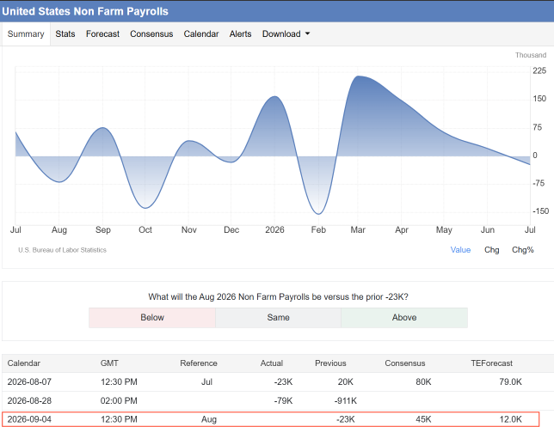
With Jackson Hole concluded, market attention is rapidly shifting to the U.S. August employment data. The Bureau of Labor Statistics confirmed the August jobs report will be released on September 4, with markets expecting an addition of 45,000 jobs. In July, non-farm payrolls decreased by 23,000, the unemployment rate stood at 4.1%, and job numbers for May and June were revised down by a cumulative 103,000.
Prior to Friday's NFP release, this week will also feature JOLTS job openings, ADP employment, ISM Manufacturing and Services data, and initial jobless claims. These figures will provide critical new inputs for the Fed's September meeting.
Market Outlook
As of 10:25 Beijing time, gold has dropped to $4,426.44, hitting an intraday low of $4,418—a significant pullback from its recent peak near $4,700.
In the short term, the primary focus is on whether the $4,400–$4,420 zone can hold as support, with overhead resistance monitored near $4,450–$4,470. Looking ahead, the U.S. employment data and subsequent remarks from Fed officials will be pivotal in determining whether gold can halt its decline and climb back above the $4,500 mark.