

I. Event Overview
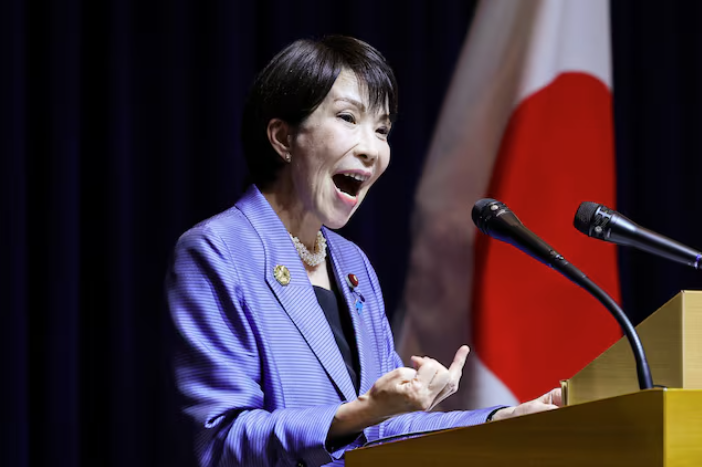
On November 11, 2025, remarks made by Japanese Prime Minister Sanae Takaichi regarding Taiwan last Friday triggered a diplomatic dispute with China. When responding to opposition lawmakers in the parliament, she stated that if China attempts to fully control Taiwan using warships and military force, it could constitute a "threat to Japan’s survival" under Japanese law, allowing the Self-Defense Forces to be deployed.
She further added that if China blockades Taiwan and attacks U.S. warships sent to break the blockade, Japan may need to intervene militarily for self-defense and to assist its allies. Taiwan is only 110 kilometers away from Japanese territory, and the waters surrounding it are a critical trade route for Japan; the largest U.S. military contingent in the region is also stationed in Japan.
As a hardline nationalist, Takaichi has been in office for less than a month. Her remarks have abandoned Japan’s long-standing strategic ambiguity on Taiwan-related scenarios, aligning with similar policies of the United States. China regards Taiwan as an inalienable part of its territory and does not rule out the use of military force for reunification. The remarks have prompted an official protest from Beijing, which accuses Japan of openly interfering in China’s internal affairs. Earlier in early November, Takaichi had also angered Beijing by publicly meeting with a Taiwan representative at a regional summit in Seoul. U.S. officials claimed that Chinese leaders have ordered the military to be ready to attack Taiwan by 2027, though many analysts view this as a mobilization timeline rather than a schedule for invasion.
II. Reactions from All Parties
Japan
On Monday, Takaichi described her earlier remarks as "hypothetical" and stated that she would avoid making similar comments in the parliament in the future. Chief Cabinet Secretary Minoru Kihara reaffirmed on Tuesday that Japan is committed to the 1972 Sino-Japanese Joint Communiqué and hopes that the Taiwan issue will be resolved peacefully through dialogue. Japan also criticized a "threatening post" by a Chinese diplomat as "extremely inappropriate."
China
The Chinese Consul-General in Osaka shared news about Takaichi’s remarks with a comment that "the dirty head that sticks out must be cut off," which was later deleted. Following Japan’s protest, Beijing stated that Takaichi’s remarks seriously violate the spirit of the 1972 Communiqué—under which Japan recognizes the People’s Republic of China as the sole legitimate government of China and "understands and respects" Beijing’s position on Taiwan. China accused Japan of interfering in its internal affairs.
International Community
The incident threatens the improvement of China-Japan relations, which have stabilized in recent years between the two major Asian economies. Taiwan has not responded directly, but its strategic location impacts Japan’s security. The United States, as Japan’s ally, has maintained its strategic ambiguity on the issue.
III. Market Impact Analysis
- Escalating Geopolitical RisksThe Japanese Prime Minister’s remarks on Taiwan have triggered a China-Japan diplomatic dispute, further escalating tensions in the Asia-Pacific region and potentially affecting regional stability and trade routes. Investors’ concerns about potential conflicts have increased, driving a shift to safe-haven assets such as gold and pushing up gold prices.
- Growth Potential of Gold DemandAs China-Japan relations deteriorate and the sensitivity of the Taiwan issue intensifies, market concerns about geopolitical risks have grown. Demand for gold as a safe-haven tool is expected to rise, and investors may increase their holdings to hedge against potential economic and financial risks, leading to further upward movement in gold prices.
- Global Economic UncertaintyThe dispute may impact China-Japan trade and supply chains, exacerbating inflationary pressures. Gold typically performs strongly in such environments, with its appeal as a store of value enhanced.
IV. Technical Analysis
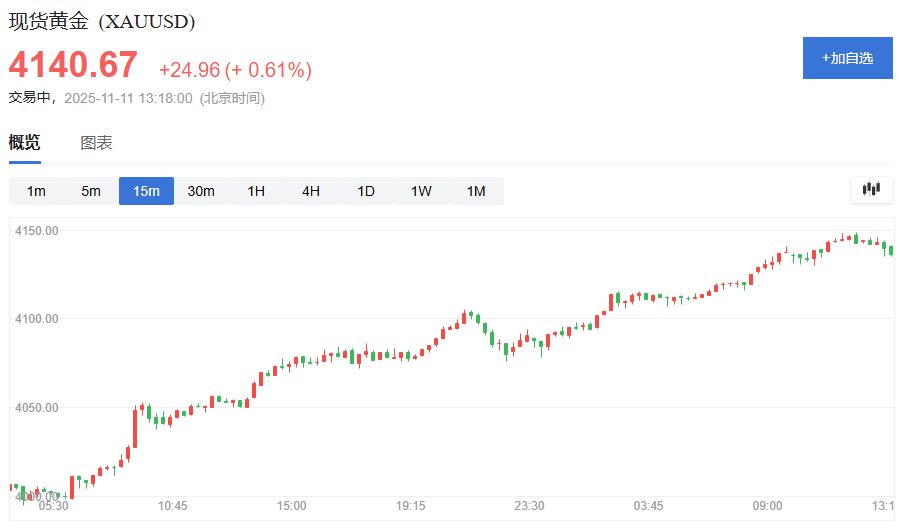
As of 13:18 Beijing Time on November 11, the spot gold price was quoted at $4,140.67 per ounce, maintaining an upward trend with market sentiment skewed toward optimism.
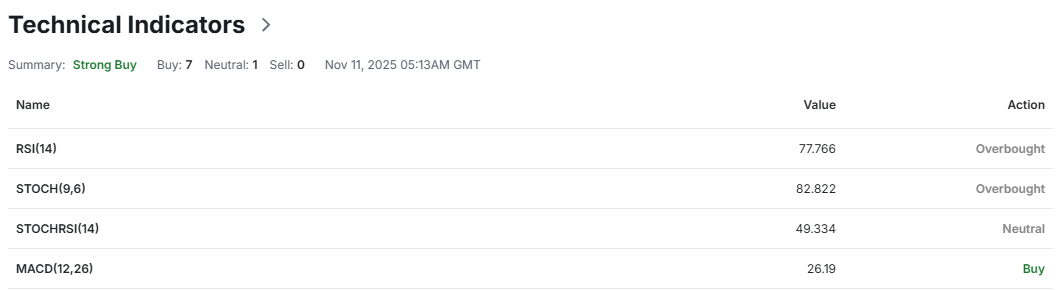
- The RSI (14) value is 77.766, in the overbought zone, indicating strong buying momentum but potential adjustment pressure.
- The STOCH (9,6) is 82.822, also in the overbought zone, sending a buying signal while hinting at short-term correction risks.
- The STOCHRSI (14) is 49.334, in the neutral zone, reflecting balanced market sentiment.
- The MACD (12,26) is 26.19 (positive), confirming short-term upward momentum.
Overall, gold prices maintain strength in the short term. Despite the presence of overbought signals, the market is dominated by buying momentum, which supports further upward movement of gold prices. From a technical standpoint, the overall outlook is "strong buy".
V. Outlook
- Long-Term Support from Escalating DisputesChina-Japan diplomatic frictions and tensions over Taiwan may further worsen geopolitical risks in the Asia-Pacific region, providing long-term safe-haven support for gold. If the remarks trigger more confrontations, gold prices are expected to continue rising as uncertainty intensifies.
- Gold’s Safe-Haven AttributeAgainst the backdrop of Asia-Pacific tensions, gold’s appeal as a hedging tool will remain high—especially amid rising concerns about trade and security.
Summary
The Japanese Prime Minister’s remarks on Taiwan have caused an uproar, escalating China-Japan geopolitical risks and driving safe-haven demand for gold. Although technical indicators point to short-term overbought pressure, the overall trend supports the rise of gold prices. Investors should closely monitor the progress of China-Japan relations and the situation regarding Taiwan, and adjust their strategies based on technical signals to cope with potential volatility.