

I. Event Overview
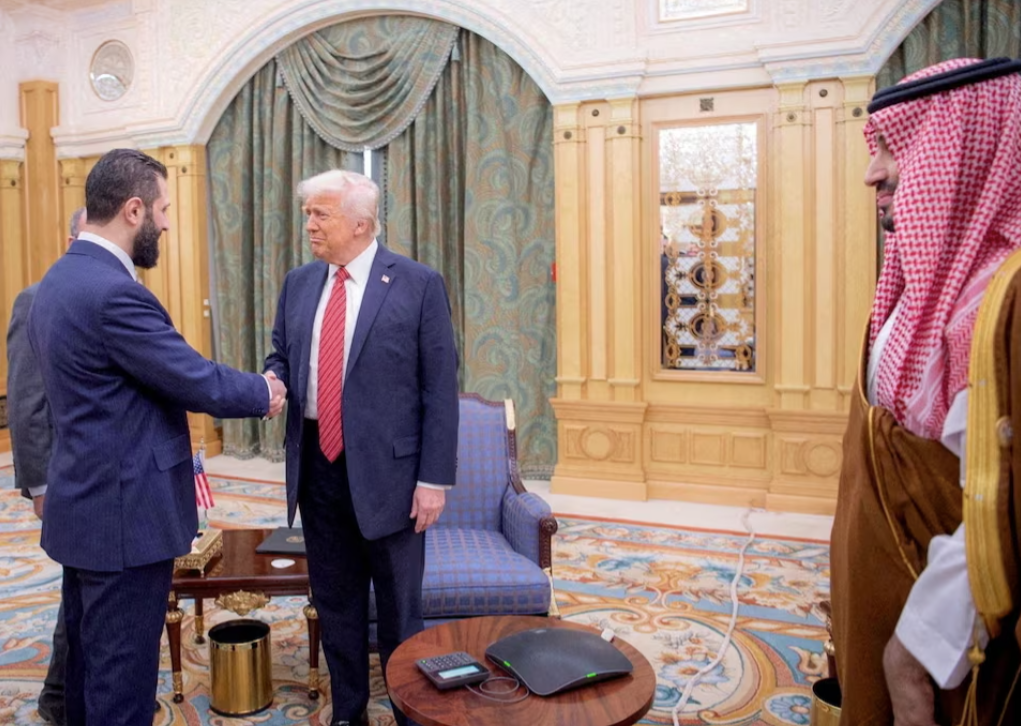
On November 10, 2025, Syrian President Ahmed al-Sharaa will meet with U.S. President Trump at the White House on Monday. This marks the first time a Syrian president has visited the White House, symbolizing Syria’s remarkable shift from international isolation to reintegration into the global community.
The two leaders first met in Saudi Arabia six months ago, and last week, the United States removed al-Sharaa from its list of "Specially Designated Global Terrorists." At the age of 42, al-Sharaa toppled Bashar al-Assad, the long-time dictator, on December 8 last year through a lightning offensive launched by Islamist militants from a northwestern enclave.
Syria has rapidly pivoted toward Turkey, Gulf states, and the United States, while moving away from Iran and Russia. The focus of the meeting is likely to include security issues: the U.S. is facilitating a Syria-Israel security agreement and plans to establish a military presence at Damascus Air Force Base. Syria may join the U.S.-led coalition against the Islamic State (IS), and this development could be formally announced during the meeting.
After their meeting in Riyadh in May, Trump announced the lifting of all U.S. sanctions on Syria. However, the most stringent Caesar Sanctions Act requires repeal by the U.S. Congress. The White House and the State Department support completing this repeal by the end of 2025, but the ongoing government shutdown may disrupt this timeline.
Al-Sharaa is expected to strongly push for the repeal of sanctions to attract global investment for the reconstruction of Syria—a country devastated by 14 years of war. The World Bank estimates that the reconstruction will cost over $200 billion. Syria’s social structure has recently been tested by sectarian violence, with more than 2,500 people killed since Assad’s ouster.
III. Market Impact Analysis
- Changes in Geopolitical RisksTrump’s meeting with al-Sharaa signals a major shift in Middle East geopolitics. Syria’s pivot to the U.S. may ease regional tensions and reduce the influence of Iran and Russia. However, risks of sectarian violence and social instability persist. While investors’ optimism about Middle East stability may reduce safe-haven demand, short-term uncertainty continues to support gold, driving its price higher.
- Potential for Gold DemandAs Syria’s reconstruction attracts investment and potential security agreements take shape, uncertainty in the Middle East may ease, weakening gold’s safe-haven appeal. Nevertheless, the repeal of sanctions requires congressional action, and amid the impact of the government shutdown, policy uncertainty has enhanced gold’s demand as a store of value, leading to higher gold prices.
IV. Technical Analysis
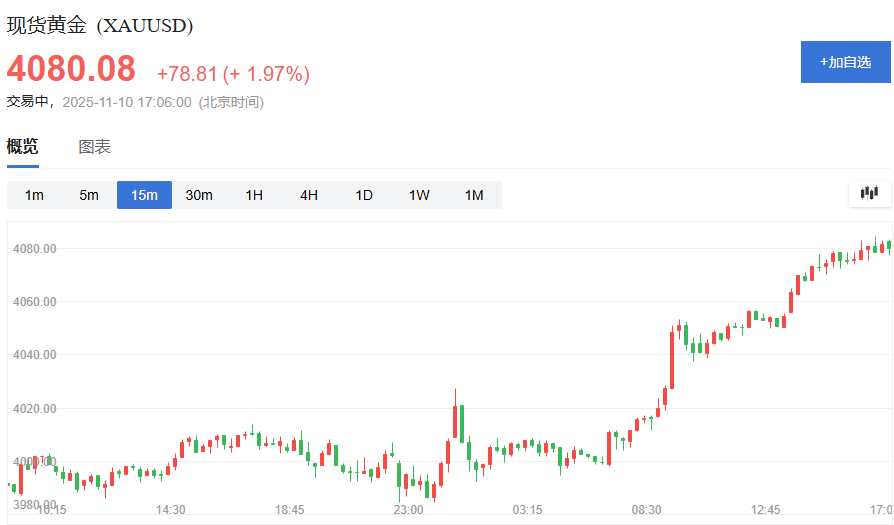
As of 16:40 Beijing Time on November 10, the spot gold price was quoted at $4,084.08 per ounce, showing a fluctuating upward trend. In the short term, the volatility range of gold prices is limited, and market sentiment is skewed toward optimism.
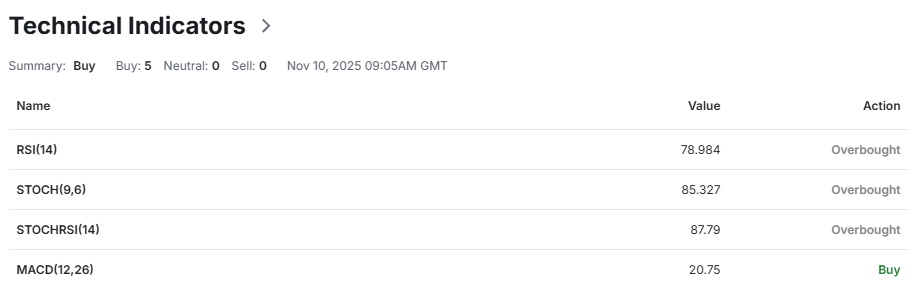
- The RSI (14) value is 78.984, in the overbought zone, indicating strong buying momentum but potential adjustment pressure.
- The STOCH (9,6) is 85.237, also in the overbought zone, sending a buying signal while hinting at short-term correction risks.
- The STOCHRSI (14) is 87.79; although it has entered the overbought zone, it has begun a gradual pullback.
- The MACD (12,26) is 20.75 (positive), confirming short-term upward momentum.
Overall, gold prices maintain strength in the short term. Despite the presence of overbought signals, the market is dominated by buying momentum, which supports further upward movement of gold prices. From a technical standpoint, the overall outlook is "strong buy".
V. Outlook
- Long-Term Impact of Geopolitical ShiftsThe improved relationship between Syria and the U.S., as well as Syria’s potential entry into the anti-IS coalition, may stabilize the Middle East and reduce safe-haven demand for gold. However, challenges in reconstruction, sectarian violence, and concerns over social stability may trigger new risks, providing support for gold. Gold prices are expected to continue rising amid uncertainties in policy implementation.
- Short-Term Correction RisksTechnical indicators show that gold is in the overbought zone, and short-term adjustments in gold prices may occur. Nevertheless, if the repeal of the Caesar Sanctions Act is delayed or tensions in the Middle East escalate, safe-haven demand will drive a rebound.
- Gold’s Safe-Haven AttributeAgainst the backdrop of geopolitical shifts in the Middle East and global investment flows, gold’s appeal as a hedging tool will remain high—especially amid uncertainties surrounding reconstruction funds and security agreements.
Summary
Trump’s upcoming meeting with al-Sharaa at the White House marks a major shift for Syria. While this may ease tensions in the Middle East, policy uncertainty persists, driving demand for gold. Although technical indicators point to short-term overbought pressure, the overall trend supports the fluctuating upward movement of gold prices. Investors should closely monitor the progress of Syria’s reconstruction and actions by the U.S. Congress, and adjust their strategies based on technical signals to cope with potential volatility.