

On June 17, 2026, the Federal Reserve held its first Federal Open Market Committee (FOMC) meeting chaired by the newly appointed head, Kevin Warsh. The Committee voted unanimously to keep the target range for the federal funds rate unchanged at 3.50%–3.75%. This meeting carried a strong "epoch-making" tone: the Fed not only drastically trimmed its policy statement and completely abandoned "forward guidance," but it also unleashed a heavy hawkish signal in its latest dot plot, hinting at potential rate hikes later this year.
I. Monetary Policy Action and the Brand-New Communication Framework
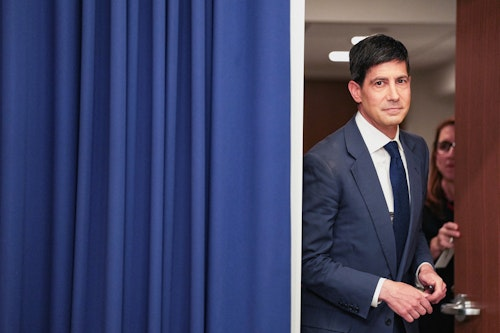
This meeting brought major overhauls to policy execution and institutional operations:
- Interest Rate Decision (12–0 Unanimous Pass): The FOMC decided by an overwhelming 12–0 vote to maintain the current interest rate level at 3.50%–3.75%. Meanwhile, the Committee reaffirmed its policy of maintaining ample reserves in the banking system.
- A Complete Makeover of the Policy Statement: The first policy statement under Warsh’s leadership was significantly shortened and simplified, removing outdated and redundant phrasing. Crucially, all forward guidance regarding the future path of interest rates was entirely deleted. During the press conference, Warsh emphasized that forward guidance is no longer suited for the current policy environment and that the market should focus more on actual economic data rather than relying on Fed guidance.
- Launching Five Special Task Forces: To comprehensively review the Fed's core business, Warsh announced the formation of five special task forces. They will focus respectively on: 1) Fed communication mechanisms; 2) balance sheet policy (assessing the ample reserves regime and asset structure); 3) the use of data sources; 4) the impact of new technologies like AI on productivity and employment; and 5) tackling inflation.
II. Assessment of Economic Conditions and Outlook (SEP Update)
Faced with a complex and tangled situation, the Fed maintained a steady outlook on the macroeconomy but showed significantly heightened concern over inflation:
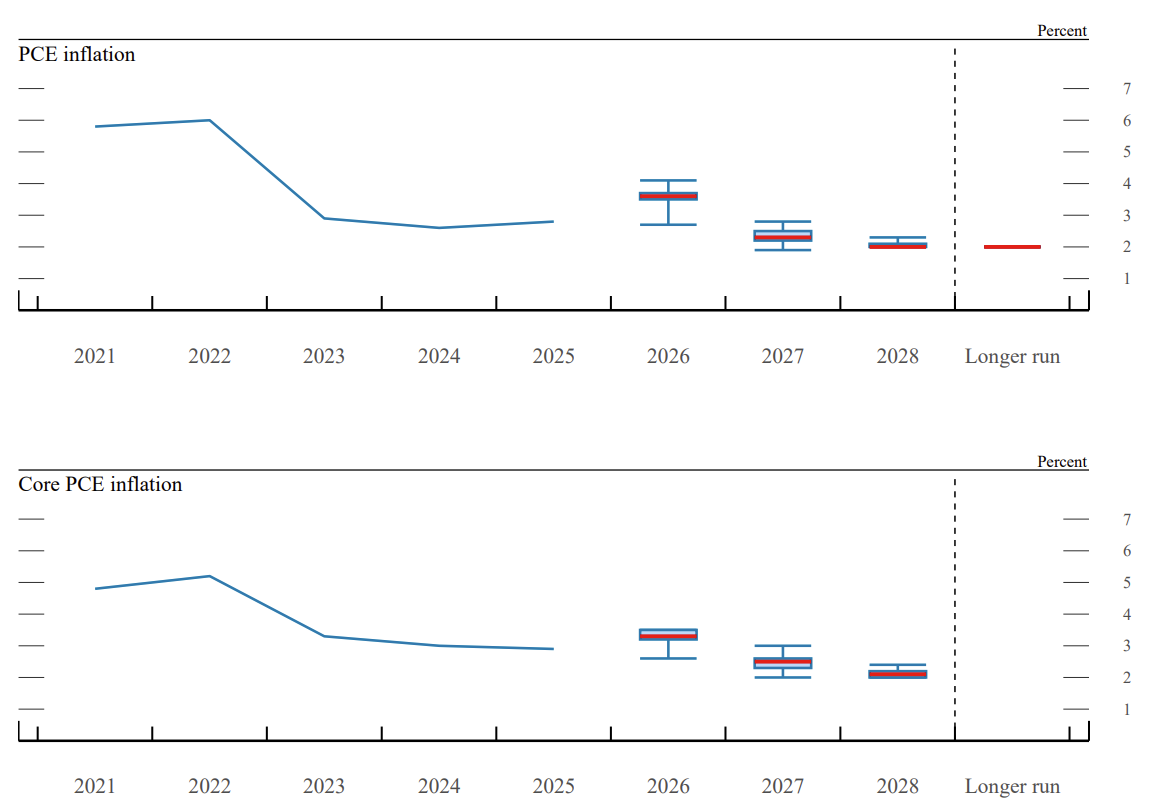
- Stubbornly High Inflation: The statement clearly pointed out that, driven by supply shocks in specific sectors like energy, inflation remains "elevated" relative to the long-term 2% goal. According to the latest Summary of Economic Projections (SEP), the median expectation for PCE inflation in 2026 is as high as 3.6%, and it is not expected to cool down to 2.3% until 2027. To this end, a rare and deeply determined pledge was added to the statement: "The Committee will deliver price stability."
- Steady Economy and Employment: Despite high uncertainty brought on by the Middle East conflict, economic activity has continued to expand at a solid pace, supported by strong capital investment and productivity growth. The SEP forecasts median real GDP growth at 2.2% for 2026 and 2.3% for 2027. The labor market remains stable, with the median unemployment rate projection for 2026 holding at 4.3%.
III. Policy Considerations and the Hawkish Reversal of the "Dot Plot"
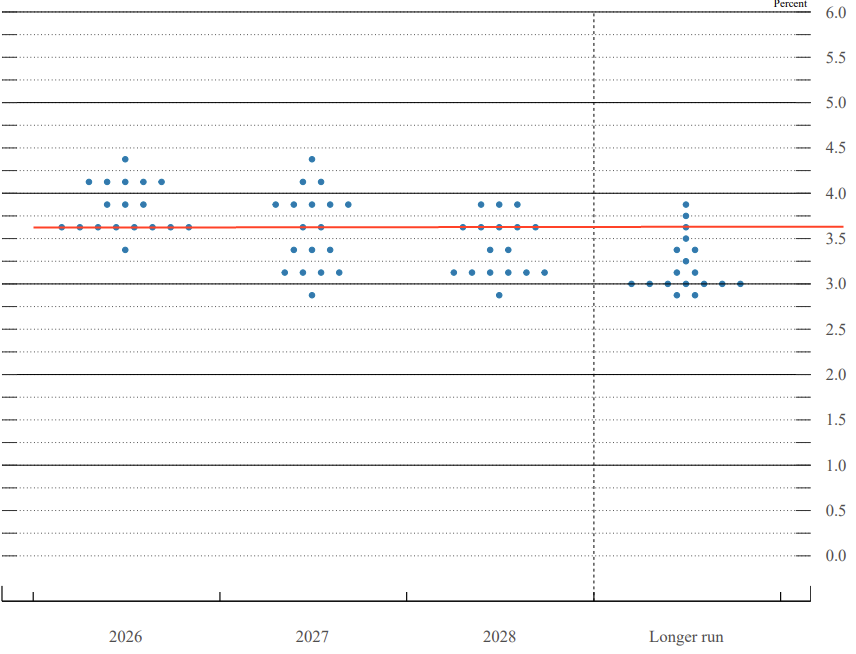
The biggest market shock from this meeting came from a complete U-turn in dot plot expectations:
- Surge in Rate Hike Expectations for the Year: SEP data showed that officials' median forecast for the federal funds rate at the end of 2026 skyrocketed from its previous low to 3.8% (which is above the current 3.75% upper limit), and the forecast for the end of 2027 landed at 3.6%. Out of 19 officials, 9 expect further rate hikes will be necessary by the end of this year.
- The Chairman Leads by Refusing to Submit a Dot: In an extremely rare move, Warsh publicly confirmed at the press conference that he did not submit his own interest rate forecast dot, stating that he found it "unhelpful" for current policy execution. He hinted that the format of the dot plot could face major adjustments or even be completely abolished in the future.
IV. Market Reaction and Political Dynamics
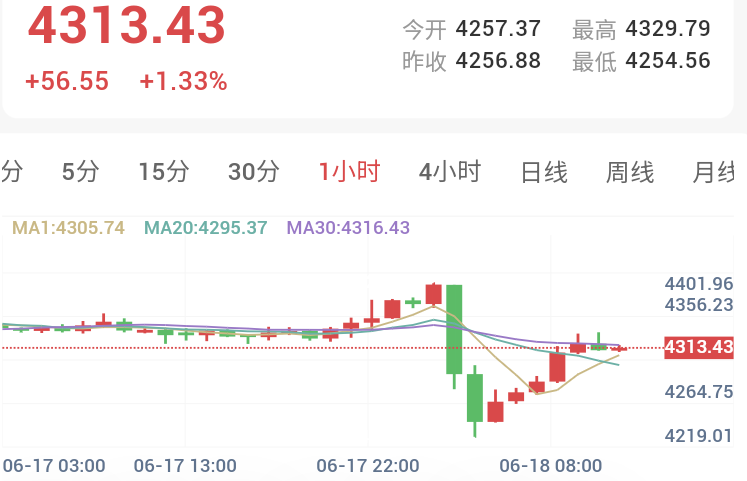
Following the announcement, financial markets were suppressed by the hawkish stance:
- Due to Warsh’s aggressive anti-inflation posture and the higher-than-expected dot plot hikes, spot gold plummeted during yesterday's trading session (June 18) from above the 4,400 mark to close at 4,256.88.
- At the same time, the three major Wall Street stock indices all closed down over 1%. The S&P 500 fell 1.19%, the Nasdaq dropped 1.32%, and the Dow Jones Industrial Average slid 0.96%. Market traders have completely given up on recent rate cut fantasies and begun pricing in the Fed's next rate hike.
- Trump's Unexpected Compromise: Although US President Donald Trump had previously demanded aggressive rate cuts from the Fed (under former Chair Jerome Powell), his attitude was surprisingly mild following this hawkish decision. Speaking from France while attending the G7 summit, Trump noted that while keeping interest rates so high was "incredible," the Fed was now captained by "a very good man," adding that he would be "guided by what he wants."
Conclusion
Chairman Warsh's debut set a brand-new tone for the Federal Reserve: pragmatic, streamlined, and iron-fisted against inflation. By scrapping forward guidance and setting up the five new task forces, Warsh is trying to break the over-reliant relationship that has formed between the market and the Fed over recent years. Confronted with a stubborn 3.6% inflation forecast, the Fed's policy center of gravity has fully shifted away from "precautionary rate cuts" toward a "hawkish defense" against an inflation rebound.
For investors, the era of blindly betting on rate cuts is over; the market must now adapt to a new trading epoch dictated by real economic data—one where the Fed stands ready to pull the trigger on rate hikes at any moment.