

I. Primary Energy Pullback and Joint US-Japan Intervention Co-Press the Dollar Index

On Monday, as a new diplomatic opening emerged in the Middle East, the macro pricing framework across global financial markets experienced notable repair. US President Donald Trump publicly indicated that diplomatic talks with Iran would commence on Monday while announcing a pause on immediate military strike operations, aiming to facilitate resolution over strait transit and related topics.
This latest clue of diplomatic engagement pushed benchmark global energy prices down by over 4% in a single session, significantly easing secondary inflation anxieties previously caused by supply chain disruptions, thereby reducing the urgency for major central banks to pursue aggressive additional monetary tightening during the second half of the year.
Concurrently, the Ministry of Finance of Japan and the US Department of the Treasury confirmed coordinated joint foreign exchange interventions buying Yen, driving the USD/JPY currency pair rapidly higher from forty-year lows to reach three-month highs. US Treasury Secretary Scott Bessent voiced support for the joint intervention, indicating potential expansion of Federal Reserve repurchase facilities to provide temporary US Dollar liquidity.
The sharp Yen rebound triggered by coordinated US-Japan intervention exerted direct overhead resistance against the US Dollar Index, marginally enhancing the attractiveness of dollar-denominated precious metals for overseas buyers.
II. Moderate Price Acceleration Supported by Bullish Moving Average Alignment
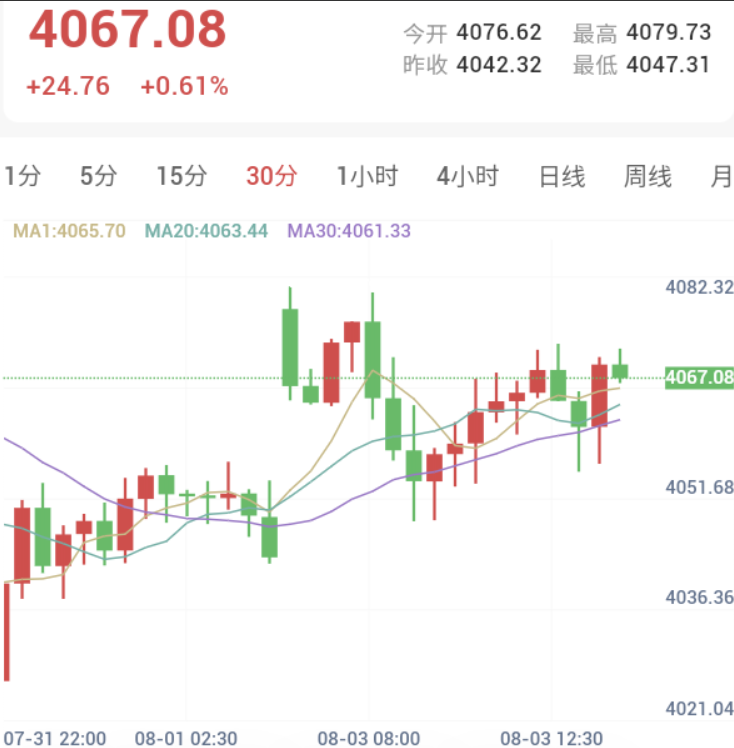
As of 14:19 Beijing time on August 3, spot gold traded at $4,067.08 per ounce, gaining 0.61% on the day (an advance of $24.76), successfully reclaiming the $4,060 handle.
Early-session base-building and step-wise rally:
Gold opened at $4,076.62 today. After touching an intraday low of $4,047.31 in early trading, dip-buying actively stepped in. The price printed a series of bullish candlesticks, grinding higher to touch an intraday high of $4,079.73, before consolidating laterally around $4,067.08.
Moving average system displays smooth bullish alignment:
The current MA1 ($4,065.70), MA20 ($4,063.44), and MA30 ($4,061.33) have all drifted beneath current price action, building a tiered dynamic support structure across the $4,061 to $4,065 zone. Following a low-level bullish crossover, the moving average band flattened and tilted upward, indicating constructive technical turnover above key averages following the morning advance.
III. 30-Minute Technical Indicators Signal Strong Buy
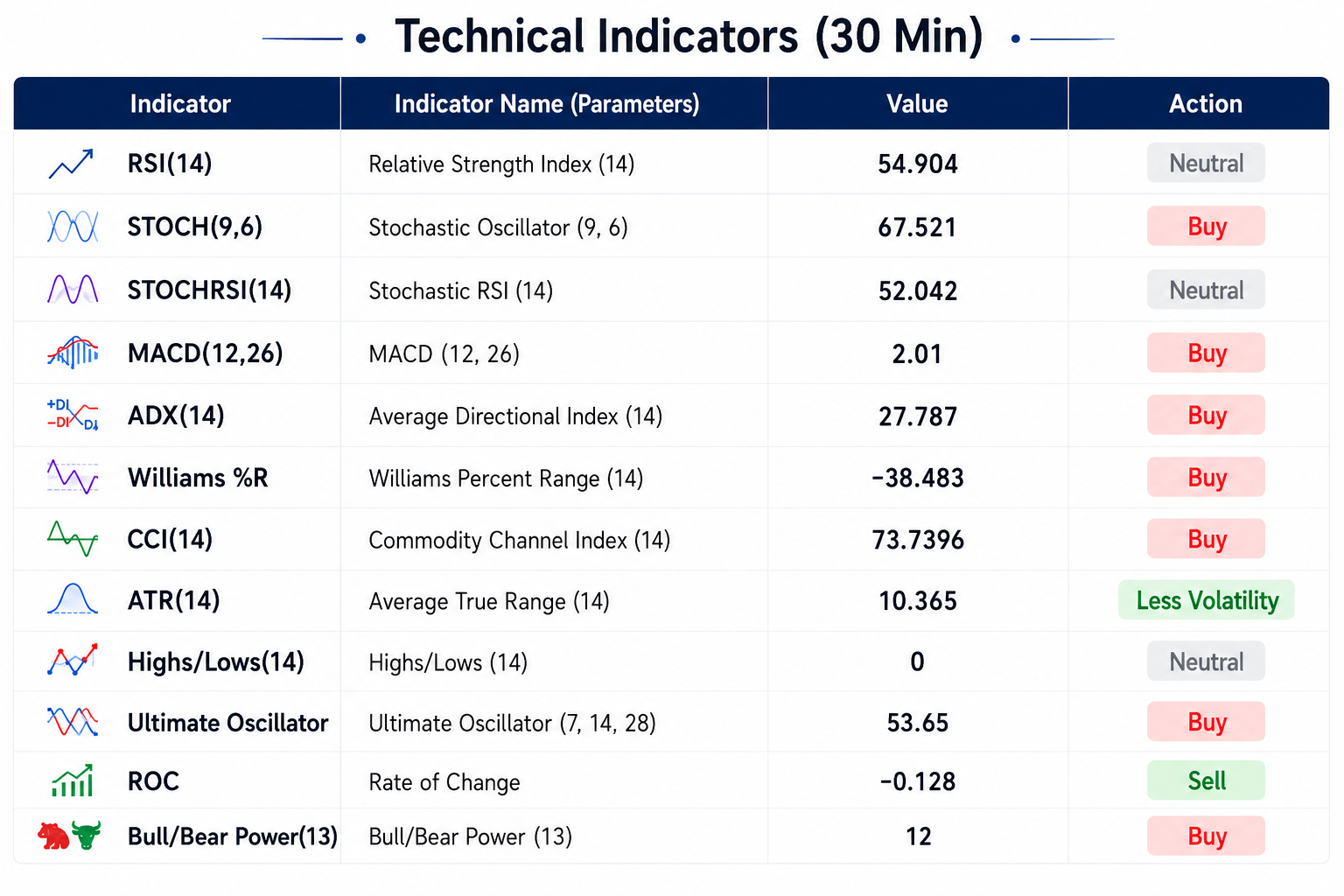
According to live 30-minute technical indicator data, driven by gold's moderate $25 intraday rebound and firm positioning above moving averages, the overall technical rating stands at Strong Buy (7 bullish indicators, 3 neutral, 1 bearish), with buyers maintaining short-term control:
Core oscillators reside in healthy bullish territory:
Relative Strength Index RSI(14) prints at 54.904, residing squarely in neutral-to-bullish territory; Stochastic Oscillator STOCH(9,6) registers 67.521 issuing a buy signal; Commodity Channel Index CCI(14) stands at 73.7396, and Williams %R reads -38.483, all pointing toward bullish control.
Trend and momentum indicators show solid alignment:
Medium-term directional gauge MACD Level(12, 26) registers 2.01 with persistent buy prompts; Average Directional Index ADX(14) reads 27.787 indicating an active buy state, reflecting a measured rally trajectory that remains comfortably below overbought thresholds; Bull/Bear Power reads 12.00 in positive territory, signaling healthy buying interest.
Market Summary
Overall, today's gold market benefited from the dual catalysts of a 4% plunge in energy benchmarks driven by US-Iran peace talks and a weakening US dollar under joint US-Japan market intervention. From a macro perspective, easing inflation concerns reduced market expectations for aggressive central bank rate hikes.