

I. Introduction: A Key Test After June Weakness
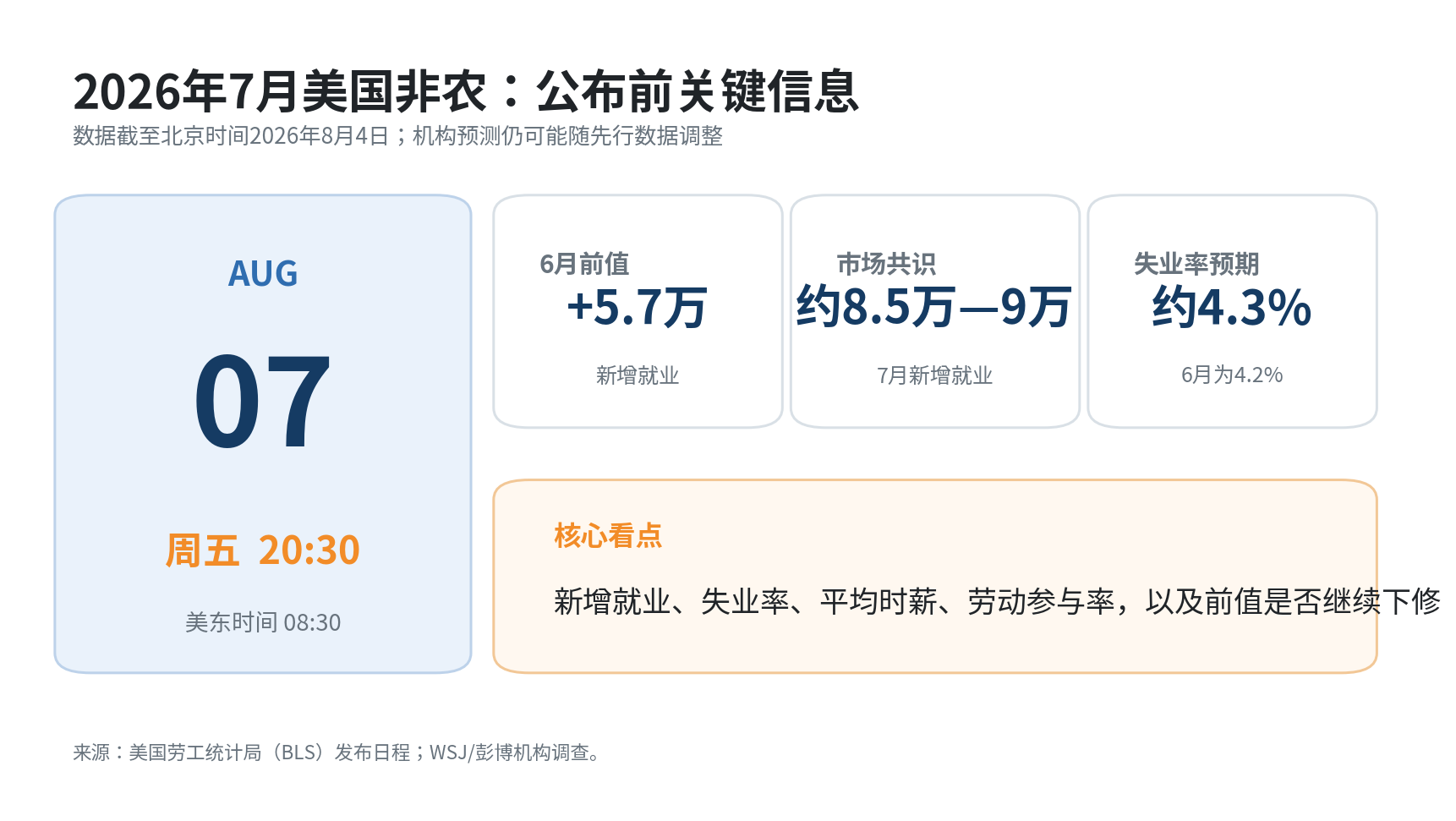
The US Bureau of Labor Statistics will release the July employment report on Friday, August 7, 2026, at 8:30 AM Eastern Time (20:30 Beijing Time). This report arrives against the backdrop of significant cooling in June payrolls, the Federal Reserve maintaining elevated interest rates, and a tentative rebound in manufacturing activity. Consequently, it will serve as a crucial benchmark for reassessing US economic resilience and the future trajectory of monetary policy.
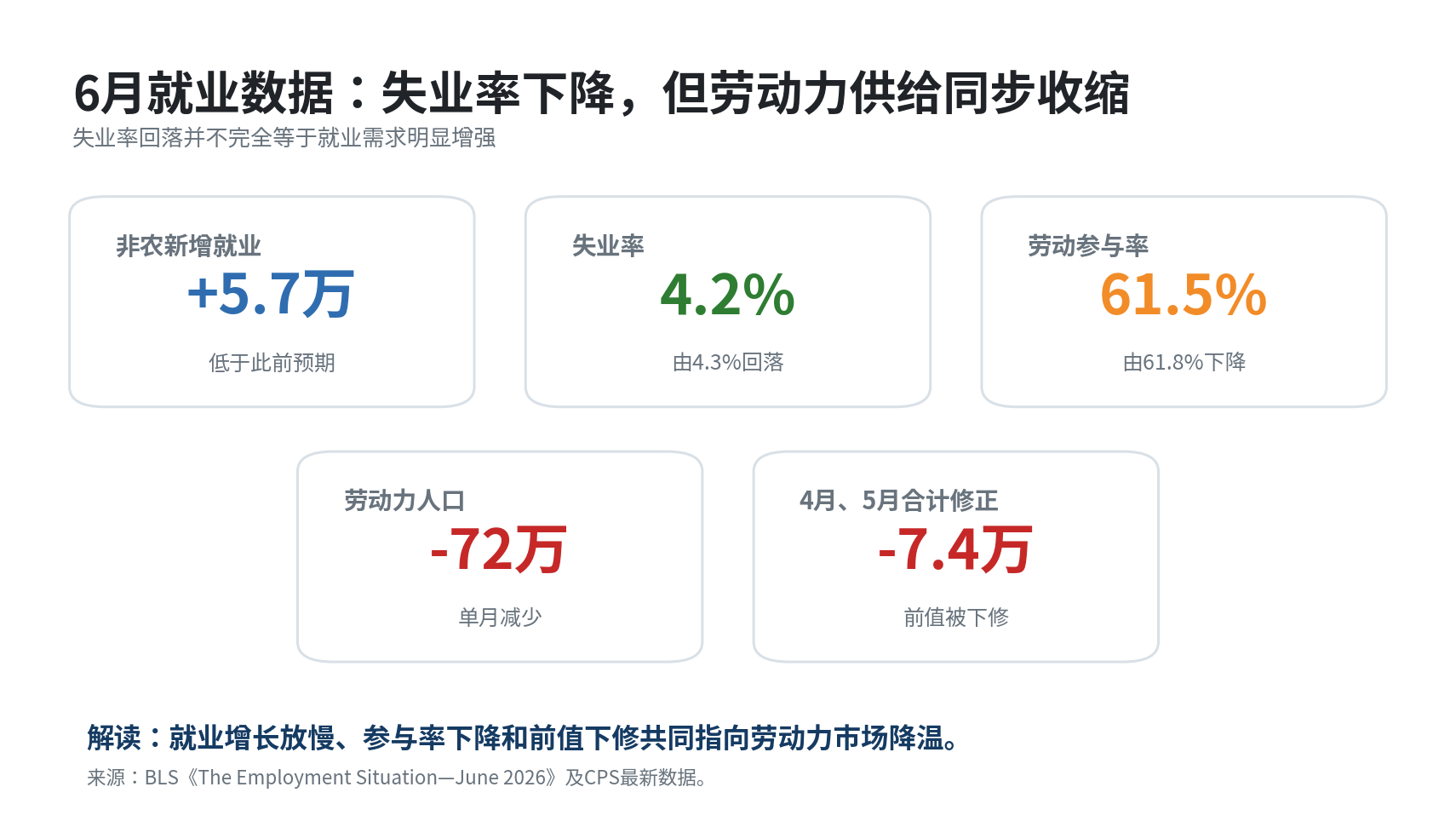
In June, US non-farm payrolls added just 57,000 jobs, falling substantially short of consensus expectations. Although the unemployment rate edged down from 4.3% to 4.2%, the labor force participation rate fell from 61.8% to 61.5%, with the total labor force contracting by 720,000 in a single month. Furthermore, combined downward revisions to April and May payrolls totaled 74,000, further reinforcing signals of slowing job growth.
Conversely, July manufacturing surveys pointed to a recovery in production and new orders, with the employment sub-index returning to expansionary territory. This sets up the central debate for the upcoming payroll release: Was June's weakness merely a temporary blip, or does it signal a more pronounced cooling phase in the labor market?
II. Core Employment Metrics Outlook: A Rebound Likely, but Limited in Scale
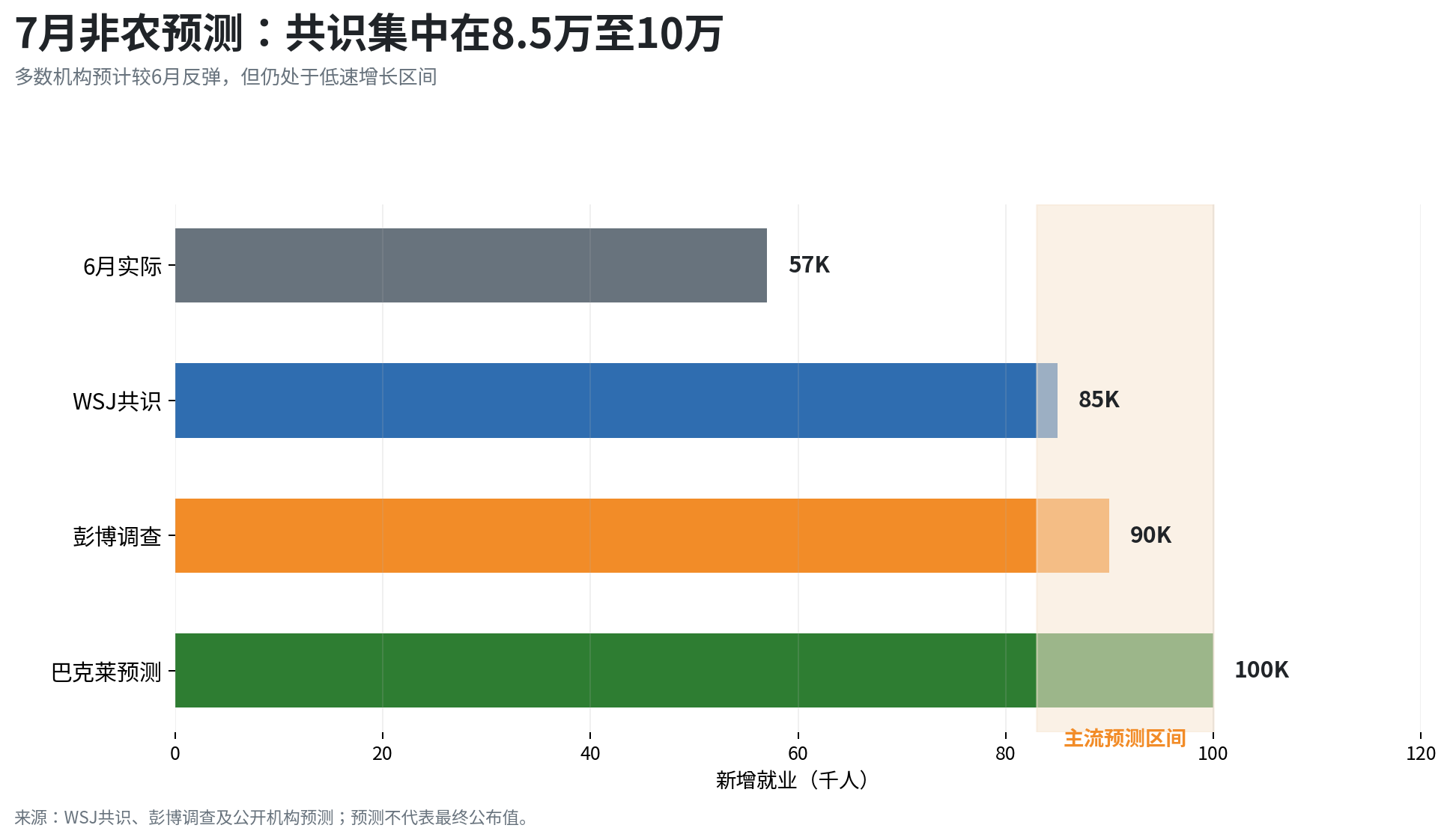
Institutional forecasts display moderate divergence, with consensus estimates largely clustered between 80,000 and 100,000 additions. Survey medians range around 83,000 to 90,000, while select institutions project gains near 100,000. The baseline scenario envisions a modest bounce from June's depressed levels while remaining within a subdued growth band. Should the unemployment rate tick back up to 4.3%, it would further align with a "moderate labor market cooling" narrative.
Wage growth will be equally critical. In June, average hourly earnings rose 0.3% month-over-month and 3.5% year-over-year. If July payroll additions remain weak while wage growth continues at a brisk pace, markets may face a conflicting combination of "slowing hiring with sticky inflation." Conversely, if both employment and wages cool simultaneously, the urgency for further Federal Reserve policy tightening will wane.
III. Leading Indicator Signals: Manufacturing Improves, but Broad Hiring Unconfirmed
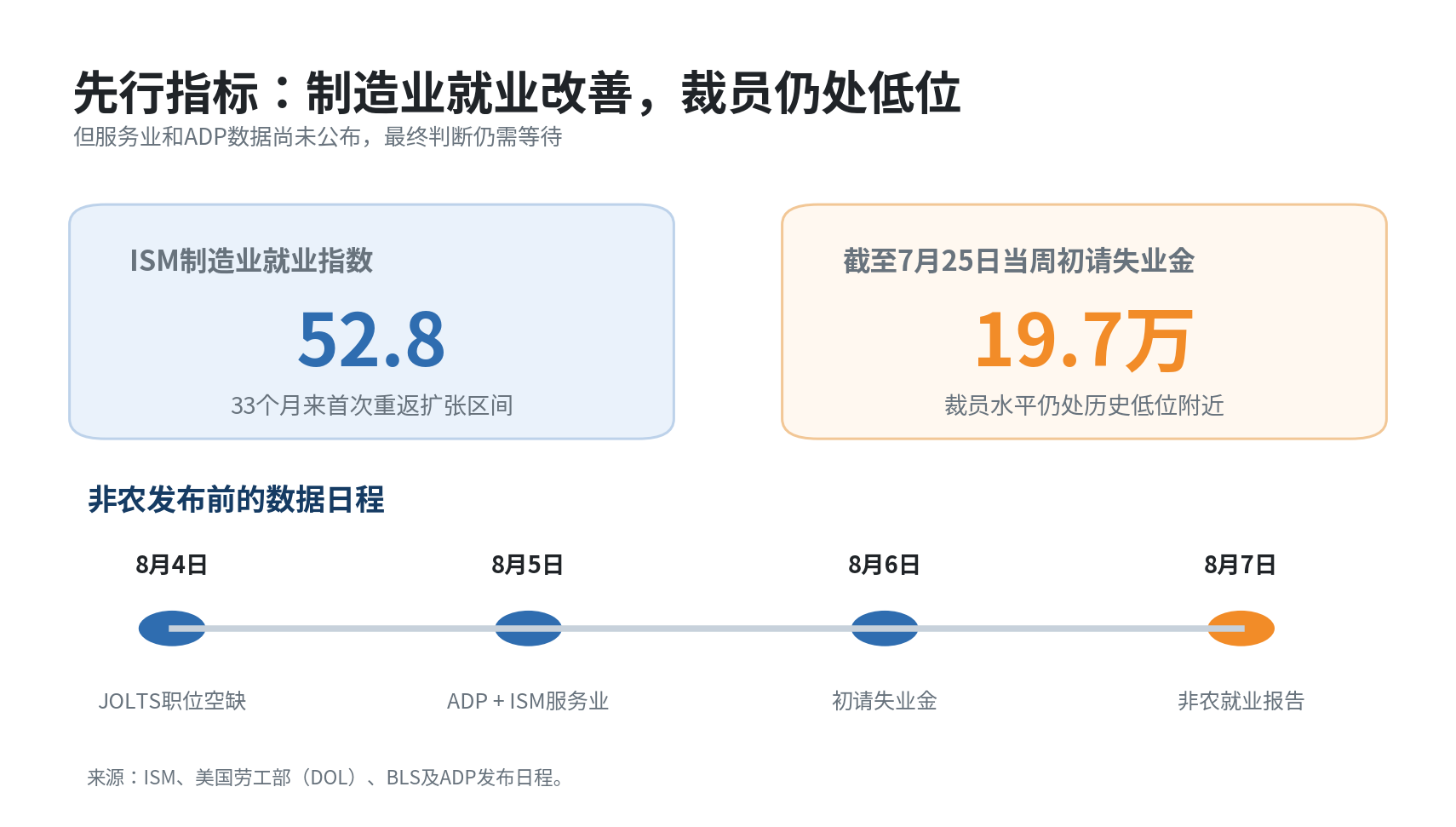
July brought positive shifts in manufacturing employment. The ISM Manufacturing Index ticked higher relative to June, with its employment sub-component re-entering expansion zone and offering a positive signal for non-farm payrolls. However, manufacturing accounts for a minor share of total US employment and cannot serve as a standalone proxy for broader labor market conditions.
Initial jobless claims remain suppressed. For the week ending July 25, initial claims hovered at low levels, indicating that widespread or rapid corporate layoffs have not materialized. The current environment resembles a "hiring slowdown" rather than "broad-based workforce reductions."
IV. Four Key Debates Surrounding the July Payroll Report
First, whether the decline in unemployment reflects genuine strength. The drop in June's unemployment rate to 4.2% occurred alongside declines in both total employment and total labor force size. In July, investors must track whether unemployment rate movements reflect genuine hiring or continued participation rate declines. If unemployment stays low while participation weakens further, labor supply contraction may mask softening labor demand.
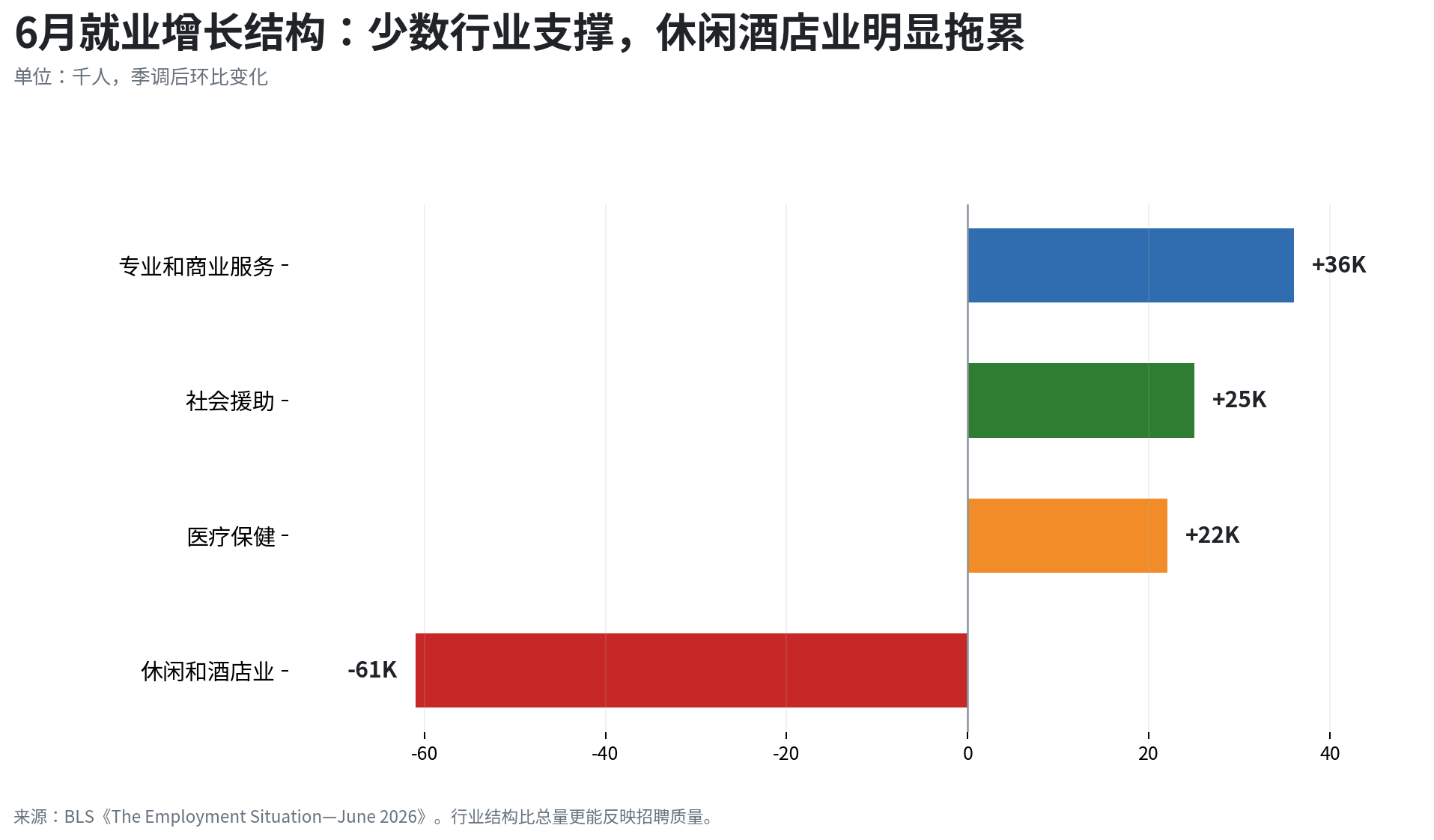
Second, whether job creation remains overly concentrated. June job gains were heavily concentrated in professional and business services, social assistance, and healthcare, whereas leisure and hospitality payrolls dropped sharply. If July gains rely on a handful of sectors, headline rebounds will fail to confirm a broad-based recovery in corporate hiring confidence. Broad-based improvements across manufacturing, construction, and services would signify a higher-quality rebound.
Third, whether prior figures will suffer further downward revisions. Combined revisions to April and May reduced job gains by 74,000, showing that initial estimates may have overstated hiring momentum. While markets focus primarily on headline monthly figures, another round of significant negative revisions to prior months would leave the overall employment trend looking weak.
Fourth, whether hiring deceleration is converting into active layoffs. Low initial jobless claims suggest firms are freezing hiring, reducing job openings, and managing payroll costs rather than conducting immediate layoffs. Sustained increases in continuing claims, long-term unemployment, or the unemployment rate would mark a transition from "low hiring" to "elevated layoffs."
V. Conclusion: Moderate Rebound More Likely Than Re-acceleration
Synthesizing available data, a moderate bounce in July non-farm payrolls compared to June appears likely, though monthly gains are expected to remain within a subdued 80,000 to 100,000 corridor. Manufacturing stabilization and low initial claims suggest the economy is not in freefall; however, falling participation rates, sectorally concentrated gains, and repeated prior-month revisions indicate underlying labor momentum is weaker than headline figures imply.
Therefore, evaluating the July payroll report requires looking beyond the headline payroll number to analyze the unemployment rate, participation rate, average hourly earnings, sectoral distribution, and prior-month revisions in tandem.