

August 2026 NFP Preview: Can Employment Escape Negative Growth?

Key Takeaway: Was July's negative payroll print merely temporary noise? If August posts only a modest rebound, the unemployment rate, wage growth, and prior-month revisions will carry far greater significance than the headline job figure alone. (Sources: BLS, DOL, Consensus Estimates; as of September 1, 2026)
1. Introduction: Critical Verification Following July's Contraction
The U.S. Bureau of Labor Statistics (BLS) will release the August Non-Farm Payrolls report on Friday, September 4, 2026, at 20:30 (Beijing Time). As one of the most critical employment indicators ahead of the Federal Reserve's September FOMC meeting, this report will directly steer market expectations regarding future interest rate trajectories.
In July, U.S. non-farm payrolls contracted by 23,000, falling well short of expectations. Additionally, May and June figures were revised down by a cumulative 103,000, bringing the three-month average gain down to roughly 20,000. However, the July unemployment rate held at 4.1%, and initial jobless claims remain anchored near 200,000, showing no signs of broad-based layoffs. The labor market currently reflects a dynamic of "sharp hiring deceleration without widespread firing."
2. Core Indicator Forecasts: Expected Return to Positive Territory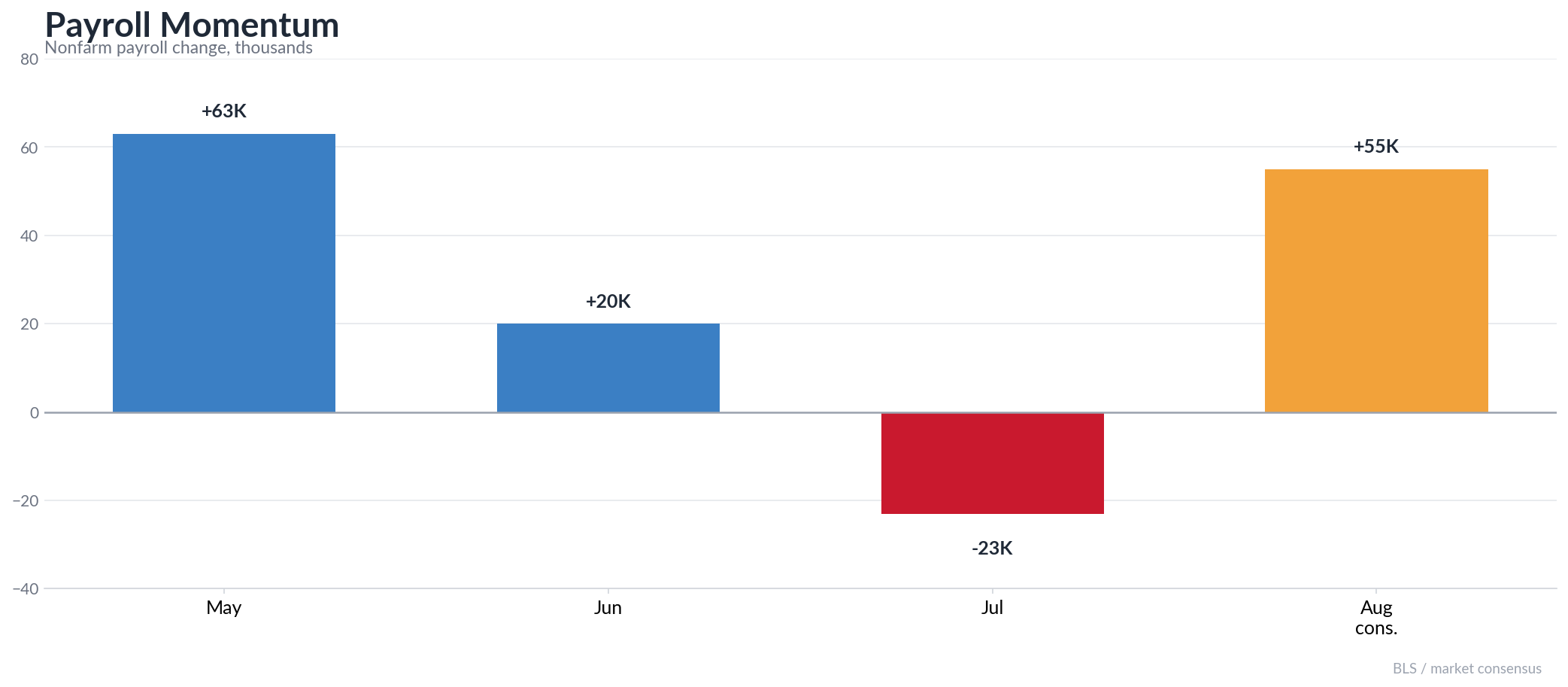
• Headline Non-Farm Payrolls: Consensus expects an addition of 50,000 to 60,000 jobs. While marking a clear recovery from July's contraction, it remains at the lower end of historical expansion ranges;
• Unemployment Rate: Projected to hold near 4.1%, with some institutions forecasting a slight uptick to 4.2%. Given the ongoing decline in labor force participation, a low unemployment rate does not entirely signal robust labor demand;
• Average Hourly Earnings: Expected to rise 0.3% MoM. Any upside surprise in wage growth could reignite market concerns over inflation persistence.
3. Leading Indicators: "Low Hiring, Low Firing" Pattern Persists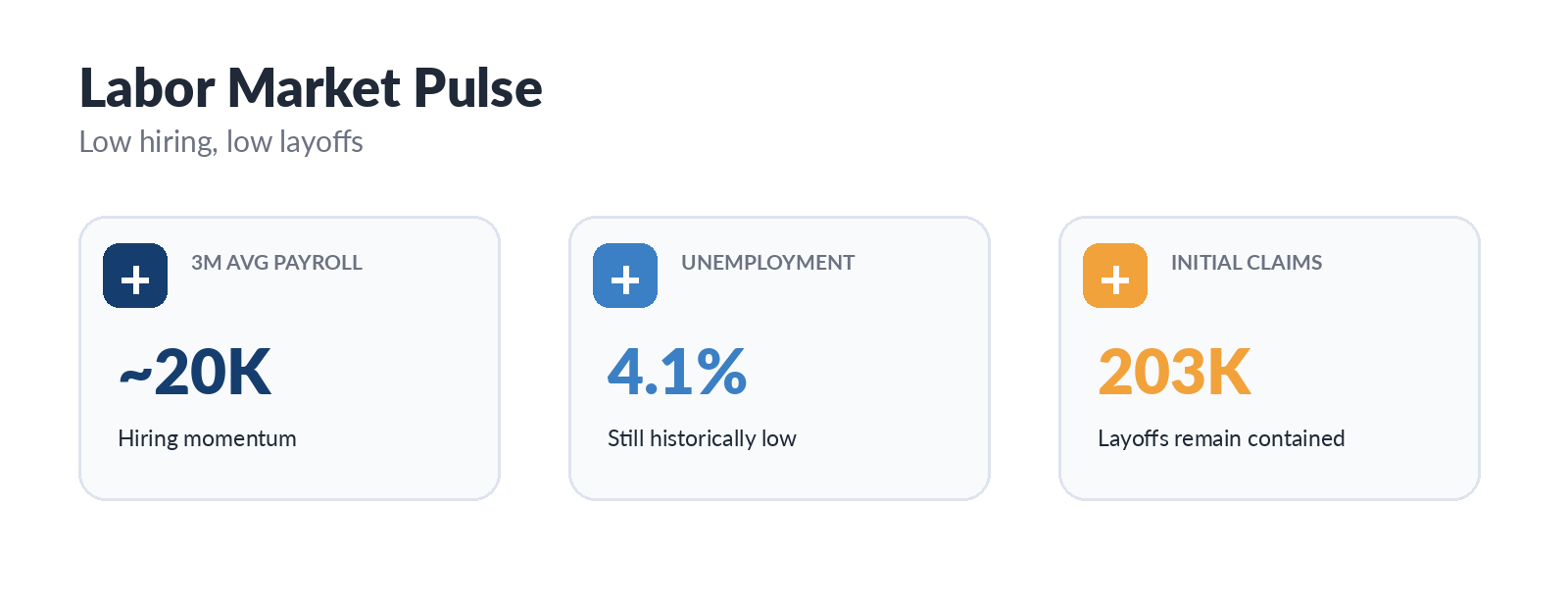
July ADP private payrolls increased by only 44,000, reflecting corporate reluctance to expand headcounts. Manufacturing employment metrics improved slightly, offering mild support. Meanwhile, initial jobless claims through late August stayed steady just above 200,000 without acute deterioration.
Consequently, the current labor market does not mirror a classic recessionary breakdown, but rather cautious hiring under cost-control measures. Upcoming JOLTS, August ADP, and ISM Services employment data will further calibrate pre-NFP expectations.
4. Three Critical Dimensions to Watch in This Report
• Quality and Breadth of the Rebound: A headline print of 50,000 to 70,000 merely signals technical recovery from July's drop. Confirmation of broader labor stabilization requires synchronized gains across manufacturing, construction, and services;
• Magnitude of Prior Revisions: Payroll data has faced consistent downward revisions in recent months. Even if August meets expectations, substantial downward adjustments to June and July could lead markets to interpret the report as fundamentally weak;
• Wage Pressures and Inflation Stickiness: A scenario of "moderate hiring with strong wages" will likely keep the Fed hawkish. Conversely, a simultaneous cooling in both employment and wages would significantly ease rate hike pressures.
5. Fed Policy Implications and Market Reactions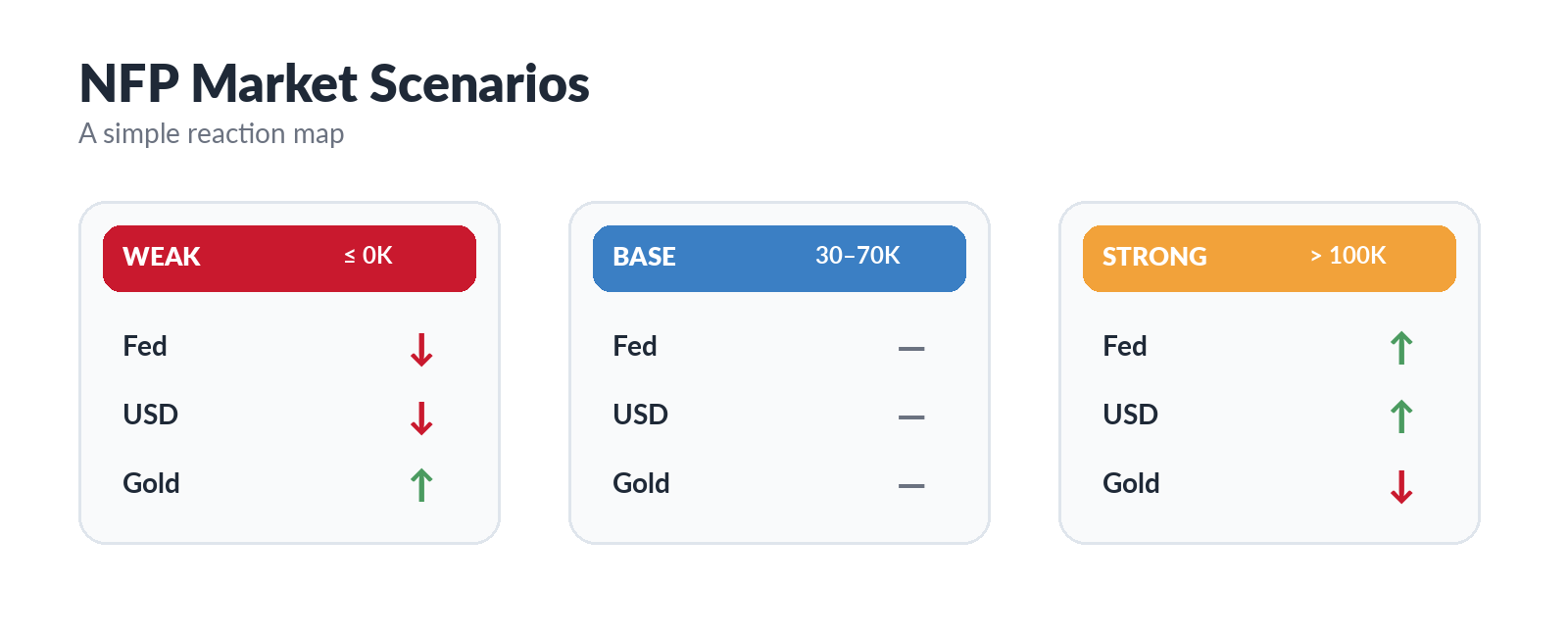
• Stronger-than-Expected Scenario (>100k with Solid Wage Growth): Markets would view July's weakness as transitory, boosting rate hike odds. This would push the U.S. dollar and Treasury yields higher while pressuring gold;
• Base-Case Scenario (30k-70k with Stable Unemployment): Consistent with a moderate labor cooling path, leaving rate expectations relatively stable and shifting market attention to upcoming inflation data;
• Weaker-than-Expected Scenario (Near Zero/Negative or Sharp Downward Revisions): Fears of labor market deterioration would intensify, reducing rate hike bets. The U.S. dollar and Treasury yields would retreat, providing solid upside support for gold.
6. Summary and Outlook
Overall, while August payrolls are likely to return to positive territory with an estimated gain of 50,000 to 60,000, the labor market is far from re-accelerating. The prevailing narrative remains "low hiring, low firing." Heading into the September FOMC meeting, market participants must assess the report holistically alongside unemployment, wages, and revisions, as Friday's release will serve as a key directional catalyst for gold, the dollar, and Treasuries.