

U.S. Strategic Energy Reserves Bottom Out, Gold Consolidates
1. News & Events
On Tuesday, U.S. energy reserves dropped to a four-decade low: Data from the U.S. Department of Energy showed that after years of continuous releases, U.S. energy reserves have fallen to 289.7 million barrels, the lowest level since 1982. Energy engineering experts warn that the safe operational baseline for reserve facilities is approximately 250 million barrels. Continuing massive drawdowns to stabilize global commodity markets disrupted by the current Middle East conflict poses severe risks to underground storage infrastructure. The depletion of this strategic buffer significantly limits Washington's policy flexibility to manage future supply shocks.
U.S. Firms Take Over Venezuelan Energy Projects: U.S. officials confirmed that American energy company NABEP will take over multiple foundational energy extraction projects in Venezuela, previously operated by Chinese and Russian firms. This takeover is part of a broader production agreement between the U.S. and Venezuela, aiming to channel Venezuela's massive proven reserves directly into the U.S. domestic market, thereby reshaping the country's energy industry landscape.
2. 30-Minute Chart Analysis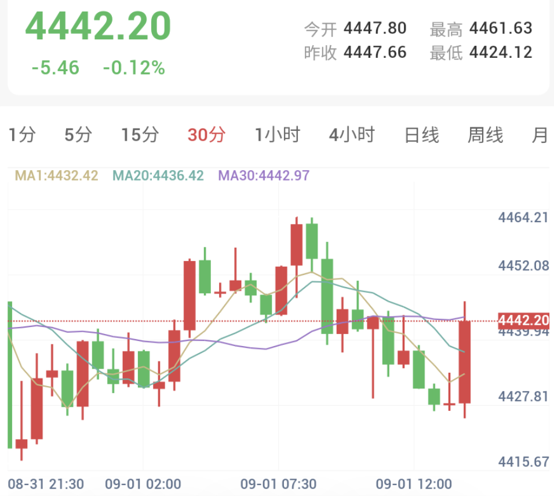
As of 13:53 Beijing time, spot gold traded at $4,442.20/oz, down slightly by 0.12% (a drop of $5.46) intraday.
During the early session, gold faced a rapid sell-off, touching an intraday low of $4,424.12. However, upon approaching the key downside support zone, short-term selling pressure exhausted, and technical buying intervened, pushing the price into a consolidating rebound.
Looking at the moving average system, alongside the bounce from the lows, the current MA1 ($4,432.42) and MA20 ($4,436.42) have formed short-term dynamic support below the price. The candlestick is currently hugging the overhead MA30 ($4,442.97) in a tight horizontal tug-of-war. The early morning downward gravity has been neutralized, and the market has entered a consolidation phase ahead of its next directional move.
3. 30-Minute Technical Indicators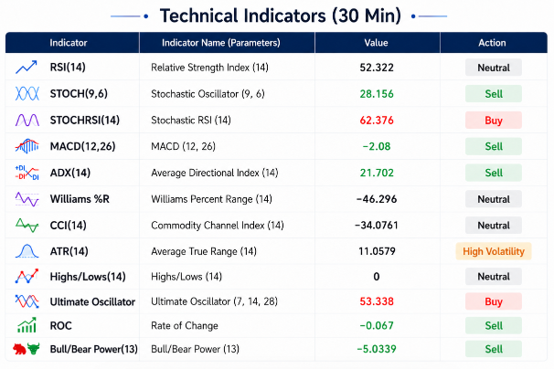
On the 30-minute timeframe, the overall technical assessment has shifted to a mild "Sell" bias (2 Bullish, 4 Neutral, 5 Bearish). However, a large concentration of core oscillators rests in neutral territory, indicating that after the rapid drop, the market is undergoing momentum repair:
• Core Oscillators Return to Neutral: The Relative Strength Index RSI(14) is at 52.32, Williams %R is at -46.30, and the Commodity Channel Index CCI(14) reads -34.08. All three indicators are operating precisely within the Neutral zone, showing no distinct directional bias.
• Divergence in Short-Term Sentiment: The fast StochRSI(14) recorded 62.38, flashing a "Buy" signal and highlighting sustained momentum from the low-level rebound. In contrast, the standard STOCH(9,6) at 28.16 indicates "Sell," reflecting lingering downward inertia from the broader cycle.
• Trend Suppression Persists: The MACD(12,26) stands at -2.08, maintaining a sell signal; the ADX(14) trend strength indicator reads 21.70 with a sell prompt. The indicator confluence suggests that while an intraday rebound has occurred, the broader bearish structure remains fundamentally intact.
4. Summary
Overall, the bottoming of the U.S. strategic reserves underscores the fragility of the global energy supply chain buffer. The market has currently categorized the Middle East situation primarily as an "inflation event." As long as foundational energy prices remain elevated, high inflation expectations will firmly lock in the central bank's tightening path. Tonight's U.S. JOLTS job openings and ISM manufacturing data (due at 22:00) will be pivotal in breaking the current gridlock. In the short term, closely monitor the defensive strength at the $4,400 support level, as well as the heavy overhead resistance in the $4,480 to $4,500 zone.