

Surging Treasury Yields Push Gold Below $4,300, Employment Data in Focus This Week
1. Gold Continues to Drop Near $4,290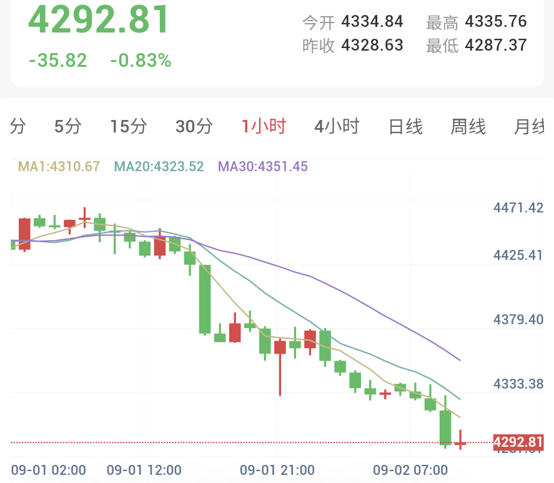
During the Asian session on September 2, spot gold extended the previous trading day's decline. As of 10:10 Beijing time, gold traded at $4,292.81/oz, down $35.82 or 0.83% intraday. The session opened at $4,334.84, peaked at $4,335.76, and touched a low of $4,287.37, decisively breaking below the $4,300 psychological mark.
In the previous session, gold briefly tumbled to near $4,322 before closing around the $4,328 level. Entering Wednesday, prices continued to fall, refreshing recent lows. On the 1-hour chart, short-term moving averages continue to slope downward, with the MA20 near $4,323 and the MA30 near $4,351. The price is currently trading below multiple key moving averages.
2. Treasury Yields Hit Highs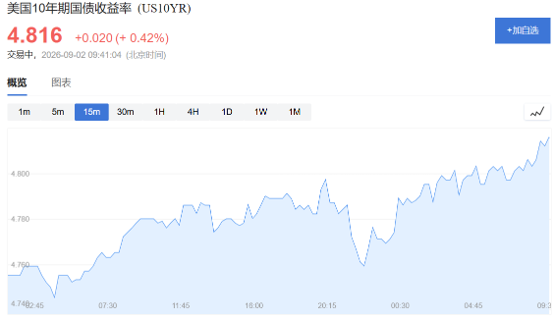
One of the primary catalysts pressuring gold recently is the continued surge in U.S. Treasury yields. The 10-year Treasury yield surpassed 4.8%, marking its highest level since January 2025, while the 30-year yield climbed to near 5.28%.
Previously, at the Jackson Hole Symposium, Fed Chair Warsh stated that the Fed's 2% PCE inflation target remains a definitive goal, emphasizing that policymakers still have work to do if core inflation does not retreat at a sufficient pace. He also noted that the U.S. labor market remains generally stable, suggesting that the primary focus should remain on price pressures at this stage.
Following his remarks, market expectations for a further rate hike in September surged significantly. Higher Treasury yields increase the opportunity cost of holding non-yielding gold, serving as a critical backdrop for the rapid decline from above $4,600.
3. Direct Military Conflict Resumes Between US and Iran
Tensions in the Middle East escalated again this week. The U.S. military launched strikes on Iranian air defense systems, radars, and related maritime facilities. Iran subsequently retaliated by using missiles and drones to attack U.S. military targets stationed in Jordan and surrounding areas.
Following the escalation, international energy prices rose rapidly, prompting markets to refocus on future inflation trajectories.
Consequently, while this round of geopolitical tension has generated some safe-haven demand, the market is currently more focused on whether rising energy costs will further exacerbate U.S. price pressures. As a result, gold has not secured significant support from the escalating conflict.
4. US Manufacturing Remains in Expansion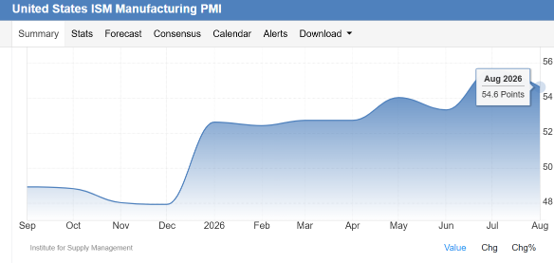
The U.S. ISM Manufacturing PMI for August recorded 54.6, down slightly from July's 55.6, but marking the eighth consecutive month of manufacturing expansion. The New Orders Index fell from 56.7 to 53.7, and the Employment Index dropped from 52.8 to 51.2, while the Prices Index remained at an elevated level of 71.1.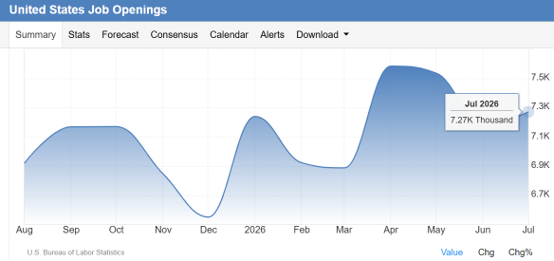
Simultaneously, U.S. JOLTS Job Openings for July stood at 7.271 million, with overall hires and separations remaining relatively unchanged, and the layoff rate holding at 1.0%. Data from the U.S. Bureau of Labor Statistics indicates that the labor market remains in a broadly stable condition.
5. Market Shifts Focus to Employment Data
Moving forward, market attention will center on U.S. employment data. The ADP employment report, initial jobless claims, and this week's Non-Farm Payrolls report will be released sequentially, directly influencing market expectations for the Fed's September meeting.
As of 10:10 Beijing time, spot gold has dropped to $4,292.81. In the short term, focus is primarily on the $4,280 to $4,300 support zone. If this level fails, the downside may extend toward previous low areas, while overhead resistance is eyed near $4,320 to $4,350. The primary drivers for gold currently remain U.S. Treasury yields, upcoming U.S. employment data, and further developments in the US-Iran situation.