


August 2026 Non-Farm Payrolls Report
1. NFP Summary: Strong Employment Rebound and Labor Force Return Boost Report Quality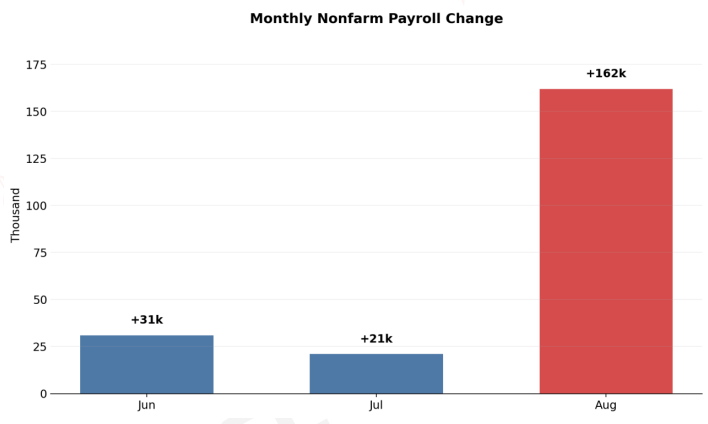
The U.S. August Non-Farm Payrolls (NFP) report came in significantly stronger than market expectations. Non-farm payrolls increased by 162,000, nearly tripling the consensus estimate of 56,000 and marking the largest single-month gain in five months. Concurrently, June's job additions were revised upward from 20,000 to 31,000, and July's figure saw a massive upward revision from a loss of 23,000 to a gain of 21,000. These revisions combined to add 55,000 jobs to the prior two months. Following these adjustments, the three-month average job growth for June to August stands at approximately 71,000, indicating that the labor market is not as close to a standstill as July's initial print suggested.
The unemployment rate held steady at 4.1% for the second consecutive month, but August's underlying structure was markedly better than July's. The labor force expanded by 683,000 during the month, and household survey employment rose by 569,000. The labor force participation rate rebounded from 61.4% to 61.6%. This implies that the low unemployment rate is no longer reliant on individuals exiting the workforce, but is instead achieved alongside more people re-entering the job market. Overall, the employment data rapidly shifted from July's "stagnation alert" to a "return of resilience."
2. Core Data Breakdown: Distinct Volume Improvement While Wage Pressures Continue to Ease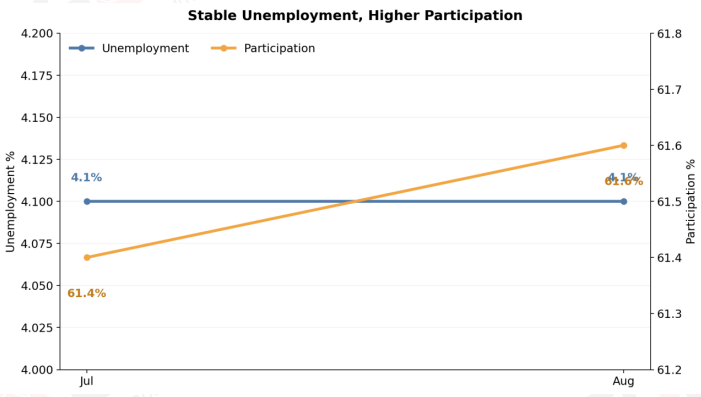
The simultaneous strengthening of job additions and upward revisions to prior months is the most critical signal of this report. The addition of 162,000 jobs in August, coupled with the 55,000 upward revision for June and July, suggests that previous assessments of a sharp labor market deceleration post-Q2 need re-evaluation. However, the three-month average of 71,000 new jobs remains below the cyclical highs seen in the spring. Thus, a more reasonable conclusion is that the labor market is recovering from a low base rather than re-entering a phase of high-speed expansion.
The household survey showed synchronized improvement. In August, total employment rose by 569,000, and the participation rate ticked up 0.2 percentage points to 61.6%. The number of people working part-time for economic reasons decreased by 414,000, pointing to a recovery in certain job quality metrics. Nevertheless, the number of long-term unemployed (27 weeks or more) increased by 159,000, and the median duration of unemployment extended from 10.5 to 11.4 weeks, indicating that finding a new job remains highly challenging for those already unemployed.
Wages and hours worked presented a combination of "stronger employment without synchronized inflation pressure." In August, average hourly earnings for all private non-farm employees rose by 0.3% month-over-month, while the year-over-year growth rate further cooled from 3.2% to 3.1%. The average workweek lengthened from 34.3 to 34.4 hours, a high since March 2024. Companies are increasing headcount and hours, but wage growth continues to decelerate, meaning the labor market itself is not currently generating a new wave of obvious wage inflation pressure.
3. Industry Structure: Reversal of July's Drags and Broadening Employment Growth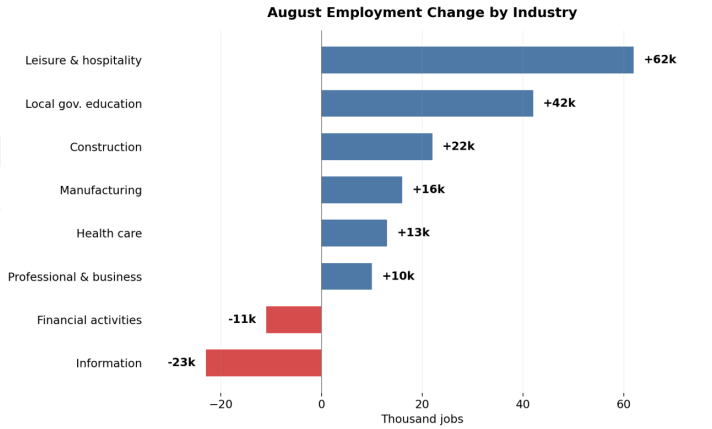
The core of August's employment rebound stemmed from leisure & hospitality and local government education. Leisure & hospitality added 62,000 jobs, including 59,000 in food services and drinking places. Local government education added 42,000 jobs, essentially reversing the sharp decline seen in the previous month. The government sector as a whole added about 35,000 jobs. These two highly volatile sectors accounted for over 60% of the month's job gains, underscoring that the extreme variations in July and August were heavily influenced by seasonal adjustments and monthly volatility.
Other industries also demonstrated some improvement. Construction added roughly 22,000 jobs, manufacturing added 16,000, healthcare added 13,000, and professional & business services added about 10,000. In contrast, the information sector shed 23,000 jobs, and financial activities lost approximately 11,000, indicating that certain white-collar and tech-related industries remain under pressure. Job gains in healthcare were also noticeably below its 12-month average of 32,000 per month.
More positively, the breadth of employment growth expanded. The report showed that 55.6% of industries recorded job gains in August, up from 52.8% in July, marking the highest level since December 2024. Therefore, the improvement this month was not entirely driven by a single industry. However, given that contributions from leisure & hospitality and local government education remain highly concentrated, trend analysis should focus on the three-month moving average in the coming months rather than relying solely on the strong 162,000 figure from a single month.
4. Market Expectations and the Fed: September Rate Hike Bets Re-ignite, But CPI Remains the Final Arbiter
Following the release of the employment data, financial markets significantly dialed up bets on a September rate hike. Pricing for a 25-basis-point rate hike by the Fed at its September 15-16 meeting rose from roughly 49% to about 62%. The Fed's current target range for the federal funds rate stands at 3.50%-3.75%. In the wake of the stronger-than-expected NFP, the U.S. dollar strengthened, Treasury yields rose, and equities faced pressure, reflecting the market re-pricing the risk of "rates staying higher or even being hiked further."
The most critical upcoming data points will be the August PPI released on September 10 and the August CPI on September 11. If inflation continues to exhibit clear stickiness, strong employment and a low 4.1% unemployment rate will bolster the case for a rate hike. Conversely, if CPI cools significantly, decelerating wage growth will provide justification for holding rates steady. In other words, the market narrative has pivoted from July's "is employment stalling?" back to "is inflation sticky enough to compel the Fed to tighten further?"
5. Summary & Outlook: Employment Recovers Resilience, But a Strong Month Doesn't Equal a Renewed Boom
The most crucial takeaway from the August 2026 NFP report is not just the headline print of 162,000 jobs, but the synchronized repair across multiple previously weak indicators: July's contraction was revised to positive growth alongside broader upward revisions; the labor force participation rate rebounded from 61.4% to 61.6%; household survey employment surged by 569,000; the number of economic part-time workers fell sharply; and the breadth of job growth expanded across industries. Together, these developments confirm that the U.S. labor market has temporarily shaken off the extreme weakness portrayed in the July report.
However, this report is insufficient to declare that the labor market has re-entered a boom cycle. The three-month average job growth is only about 71,000, the number of long-term unemployed continues to rise, and annual wage growth has dipped to 3.1%. Furthermore, a substantial portion of this month's gains came from leisure & hospitality and local government education—two highly volatile sectors. The current landscape is best described as a "low unemployment, moderate hiring, labor force returning" job market, rather than a fully overheating one.