


I. Event Overview
On October 17th, U.S. President Donald Trump held a tense meeting with Ukrainian President Volodymyr Zelenskyy at the White House, urging Zelenskyy to cede large swathes of territory to Russia—including the Donetsk and Luhansk regions—in exchange for a territorial swap. The Ukrainian delegation expressed disappointment over this proposal. Trump also refused to provide Tomahawk missiles (which can reach deep into Russian territory) and is considering offering bilateral security guarantees to both Kyiv and Moscow.
After the meeting, Trump publicly called for a ceasefire along the current frontline, and Zelenskyy subsequently agreed. Trump stated that Ukraine should "stop right where the frontline is" and argued that the Donetsk region (78% of which is already controlled by Russia) could remain in its current fragmented state, with further negotiations to take place in the future. Zelenskyy sought long-range weapons to strengthen Ukraine's resistance against Russia, but Trump emphasized the need for a quick agreement, citing concerns about escalating the war.
Sources indicated that Trump's stance was influenced by his phone call with Putin on Thursday. Putin proposed that Ukraine cede Donetsk and Luhansk in exchange for parts of Zaporizhzhia and Kherson. U.S. officials put forward the same swap plan, but Ukraine deemed it "suicidal" due to the high strategic value of the involved regions.
II. Reactions from All Parties
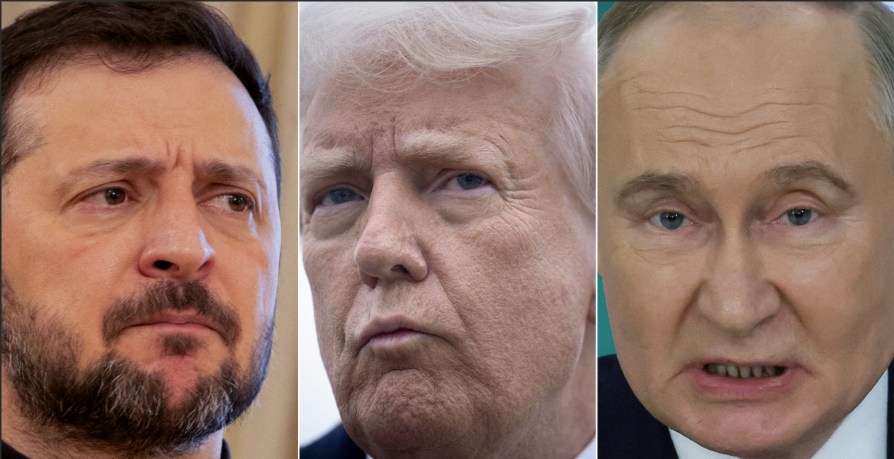
Trump argued that a ceasefire along the frontline was necessary, stating "let history decide," and claimed he had the opportunity to end the war. Zelenskyy described the meeting as "productive," expressed trust in Trump's willingness to end the war, and noted that discussions on territorial concessions were "sensitive and difficult." He added that Russia intended to retain all territories it had gained through the war.
European leaders reaffirmed their support for Ukraine. Downing Street (the UK government) stated its "firm commitment" to countering Russian aggression. Zelenskyy commented that Trump had a "major opportunity" to end the war, drawing a parallel to the ceasefire brokered in the Middle East.
The Ukrainian delegation characterized the meeting as "quite bad." Trump allegedly warned that without an agreement, Ukraine would be "frozen and destroyed"—though one source denied the use of the word "destroyed." Ukraine believes that ceding territory would leave the remaining regions more vulnerable to Russian attacks.
III. Market Impact Analysis
1. Expectations of Geopolitical Escalation Strengthen Safe-Haven Demand
Trump’s push for Ukrainian concessions and refusal to supply Tomahawk missiles signal a shift in U.S. policy toward mediating the Russia-Ukraine war, which may prolong war-related uncertainty. This amplifies the risk of conflict spillover, driving investors to turn to gold to hedge against potential territorial swaps or escalated military confrontation—creating structural buying demand. Russia may perceive this U.S. shift as a sign of weakness and step up retaliatory measures in the energy sector (e.g., cutting natural gas supplies), further disrupting global supply chains and pushing up inflation expectations. This, in turn, enhances gold’s anti-inflation attribute. In the medium to long term, if the Budapest Summit fails and negotiations collapse, funds may flow from risk assets to gold—mirroring the over 15% surge in gold prices seen in the early stages of Russia’s 2022 invasion of Ukraine.
2. Challenges to the U.S. Dollar’s Status and Fiscal Deficits
Trump’s proposal for a quick agreement may undermine coordination among U.S. allies, triggering dissatisfaction in Europe and weakening the U.S. dollar’s safe-haven function. Similar to concerns over the EU’s freezing of Russian assets, political intervention could accelerate central banks’ efforts to diversify their reserves—boosting demand for gold. Meanwhile, if U.S. aid to Ukraine is halted, Europe will be forced to bear a heavier burden, which may exacerbate concerns about fiscal deficits and impact the U.S. dollar’s exchange rate. This indirectly supports gold’s appeal as a non-sovereign asset. In the short term, gold prices may find support from rising risk aversion; however, if Zelenskyy persuades Trump to supply missiles, there will be risks of a price correction.
IV. Technical Analysis
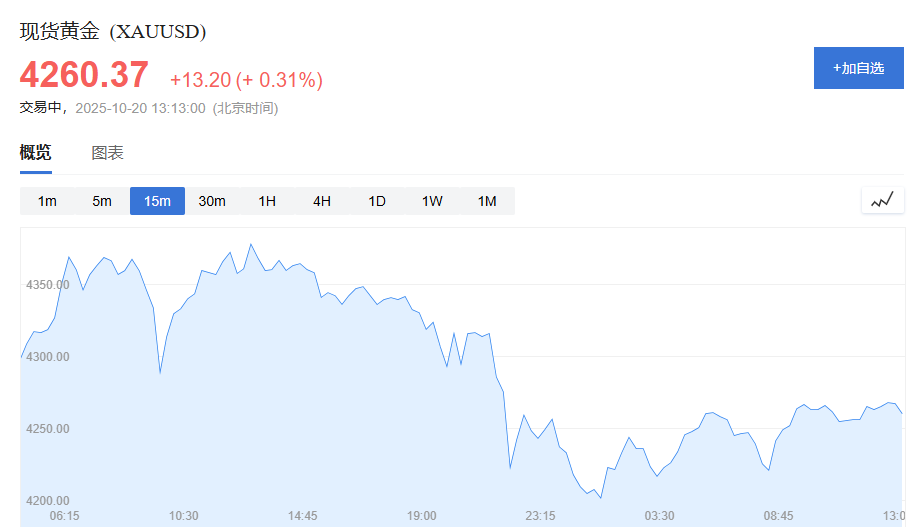
As of 13:13 Beijing time on October 20th, spot gold was quoted at $4,260.37 per ounce, trapped in a range-bound oscillation. This week, gold prices broke through historical highs, with momentum, volatility, and duration reaching multi-year extremes—indicating technical exhaustion risks. The key weekly resistance level to watch is $4,308.00 per ounce: if gold prices break through this level effectively and close firmly above it, a new round of accelerated gains may be triggered. The next technical targets would then be $4,492.00 per ounce, followed by the annual uptrend resistance level of $4,553.00 per ounce.
Overall, for the current upward trend to continue, gold prices must first hold the $4,000 support level. Additionally, they must break through and close above $4,308.00 to have a chance of initiating the next wave of rallies.
V. Outlook
1. Ukrainian Concessions and Decisions on Missile Supply
If Trump insists on territorial swaps and refuses to provide Tomahawk missiles, it may trigger dissatisfaction within Kyiv and pressure from Europe—pushing up uncertainty and benefiting gold’s safe-haven premium. Conversely, if Zelenskyy convinces Trump to supply missiles, Russia’s potential escalation would amplify the risk of conflict spillover, further driving up gold prices. In the medium to long term, a failed Budapest Summit and collapsed negotiations will stimulate safe-haven capital inflows into gold.
2. Linkages Between the Global Economy and Central Bank Policies
The U.S. policy shift may weigh on European economic growth. If the Federal Reserve accelerates interest rate cuts, gold’s yield advantage will become more prominent. Central banks (e.g., China’s) may increase their gold reserves to hedge against U.S. dollar risks, creating structural buying demand. If European allies become more deeply involved in the conflict, instability in the Eurozone will amplify systemic risks—supporting gold’s medium-to-long-term trend.
Summary
Trump’s urging of Zelenskyy to concede to Russia marks a new phase in Russia-Ukraine geopolitical tensions. This uncertainty supports gold’s safe-haven demand, though potential easing from negotiations could lead to corrections. Amid territorial disputes, inflation concerns, and energy risks, gold’s safe-haven and anti-inflation attributes have been strengthened. Investors should focus on the Budapest Summit, missile supply decisions, and Russia’s response. Technically, gold prices remain strong, and geopolitical premiums are expected to persist until the end of the year.