


I. Event Overview
On October 24, 2025, senior economic officials from the United States and China will hold a key meeting in Kuala Lumpur, Malaysia. The meeting aims to prevent the escalation of the U.S.-China trade war and ensure the smooth progress of the upcoming talks between Trump and Xi Jinping next week. The focus of the meeting is China’s expanded controls on the export of rare earth minerals and magnets, a measure seen as China’s means of exerting economic pressure on the United States. The Trump administration previously threatened to impose a 100% tariff on Chinese goods starting November 1 in response to China’s restrictions on rare earth exports. This meeting marks the fifth discussion between the Trump administration and Chinese Vice Premier He Lifeng since May, where both sides will explore ways to reach a compromise amid disputes over the global rare earth supply chain.
China dominates the global rare earth supply, and rare earth minerals are crucial for the high-tech manufacturing industry, involving the production of electric vehicles, semiconductors, and weapons systems. The U.S. has expressed strong opposition to China’s rare earth export controls, stating that it will not accept such restrictions and plans to take further measures, including limiting the export of critical software and other technological products to China.
II. Reactions from All Parties
In response to China’s rare earth export controls, the Trump administration strongly criticized China for attempting to control key resources in the global supply chain and threatened to further tighten trade restrictions on China. For its part, China stated that these export controls are intended to protect national security interests, particularly to prevent rare earth resources from entering the military sector. Despite the deadlock in U.S.-China negotiations, both sides are still working to avoid the outbreak of a full-scale trade war, especially ahead of the upcoming U.S.-China leaders’ meeting.
III. Market Impact Analysis
1. Escalating Geopolitical Risks
As U.S.-China trade frictions intensify, uncertainty in global markets has further increased. The Trump administration’s new export control measures against China have heightened investors’ concerns about the global economy and market stability. Against this backdrop, demand for gold as a safe-haven asset has received further support, and gold prices may continue to rise.
2. Potential Rare Earth Supply Disruptions May Fuel Inflation
China’s new restrictions on rare earth mineral exports may lead to disruptions in the global supply chain, particularly in the high-tech industry, which in turn will push up the production costs of related products. Such supply shortages and inflation expectations will drive demand for gold as an inflation hedge, thereby underpinning gold prices.
3. U.S. Dollar May Come Under Pressure
Tensions in U.S.-China trade relations may put pressure on the U.S. dollar, especially if the United States adopts tougher economic measures. A weaker U.S. dollar usually prompts investors to turn to non-yielding assets such as gold, further pushing up gold prices.
IV. Technical Analysis
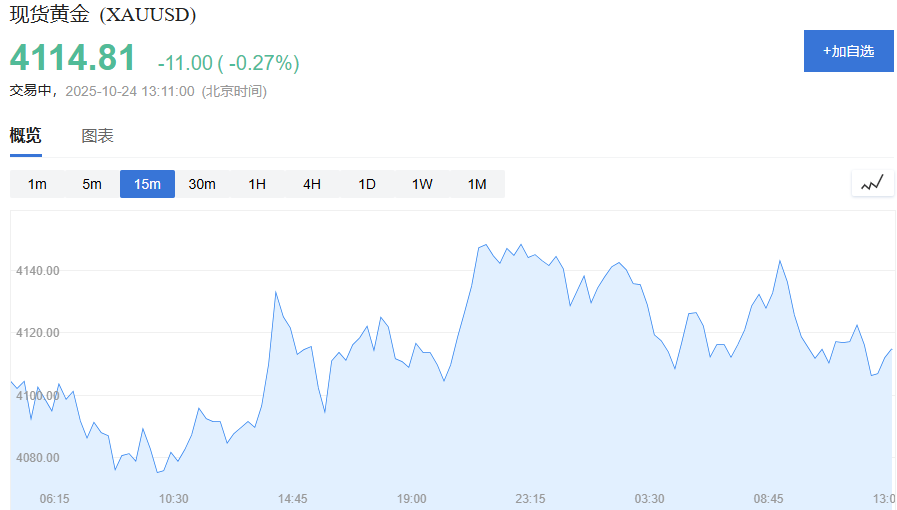
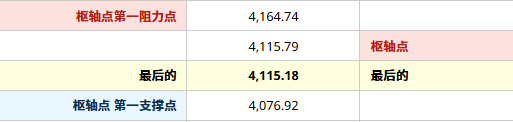
As of 13:11 Beijing Time on October 24, the spot gold price was quoted at $4,114.81 per ounce. The 15-minute chart shows that gold maintains a volatile downward trend. The short-term support level is at $4,076.92 per ounce; if this support is broken, gold prices may further correct to below $4,050.00 per ounce. The short-term resistance level is at $4,115.79 per ounce; after breaking through this level, gold prices may continue to rise to $4,250.00 per ounce.
V. Outlook
1. Further Escalation of the U.S.-China Trade War
If trade tensions between the U.S. and China continue to escalate—especially if the U.S. further restricts the export of critical technologies and goods to China—uncertainty in global markets will continue to drive safe-haven demand for gold. Gold prices may rise further and break out of the current volatile range.
2. Rare Earth Supply Restrictions Boost Gold Demand
China’s restrictions on rare earth exports may push up the costs of global energy and technological products, leading to rising inflation expectations. This will further support the attractiveness of gold as an inflation-resistant asset.
3. Impact of a Weakening U.S. Dollar on Gold Price Trends
If the U.S. dollar weakens further under the pressure of global economic uncertainty, the attractiveness of gold as a non-yielding asset will increase, and gold prices may maintain a strong upward trend in the coming period.
Summary
The escalation of U.S.-China trade frictions and China’s controls on rare earth exports have further heightened uncertainty in global markets, supporting demand for gold as a safe-haven asset. With rising geopolitical risks and increasing inflation expectations, gold is expected to continue rising. Investors should pay attention to the future development of U.S.-China trade relations and their impact on gold—gold prices may continue to maintain a strong upward trend.