

On September 17, 2025, the Federal Reserve announced a 25-basis-point cut to the target range for the federal funds rate, bringing it to 4.00%–4.25%. This move marks the official entry of monetary policy into an easing cycle. The minutes showed that committee members held differing views on the economic outlook, labor market softness, and inflationary pressures. Newly appointed Governor Stephen I. Miran cast the lone dissenting vote, pushing for a larger rate cut. Here is a breakdown of the core elements from the meeting:
I. Core Meeting Content: Rate Cut Decision and Internal Divisions
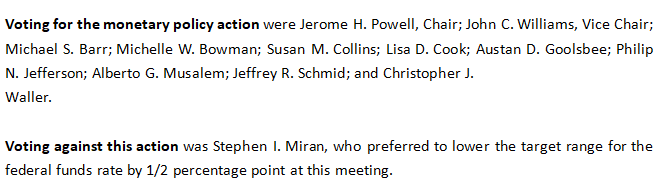
Interest Rate Decision: A 25-Basis-Point Cut and a Dissenting Vote
The FOMC passed the resolution to cut interest rates by 25 basis points by an 11–1 vote, lowering the target range for the federal funds rate to 4.00%–4.25%. Newly appointed Governor Stephen I. Miran cast a dissenting vote, arguing that a 50-basis-point cut was warranted. His reasons included further weakening of the labor market, actual inflation tracking close to the 2% target, and a lower neutral interest rate driven by rising tariff revenues and tightening immigration policies.
Economic Assessment: Slowing Growth and Rising Employment Risks
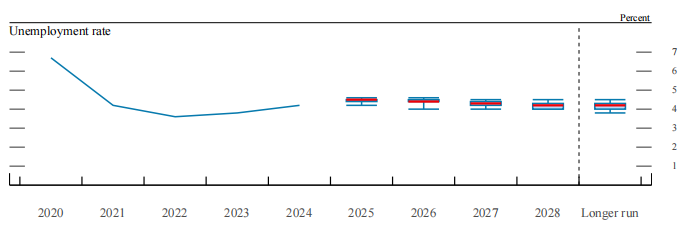
Committee members generally agreed that economic growth slowed noticeably during the first half of the year, with job growth decelerating significantly and the unemployment rate rising to 4.3% in August. Although the unemployment rate remains relatively low by historical standards, downside risks have increased significantly. Some members pointed out that labor market dynamics are weakening, as seen in falling hiring and quit rates, indicating a lack of market vitality.
Inflationary Pressures: Remaining Above Target, Debate Over Tariff Impacts
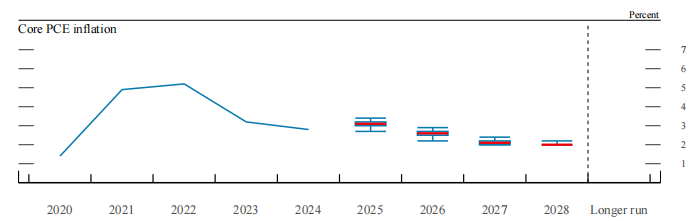
The PCE inflation rate for August stood at 2.7%, while core PCE came in at 2.9%, both tracking above the long-term 2% target. Most members believed that tariff policies implemented this year pose upward risks to inflation, though some judged that the impact could be temporary. A few members noted that if the tariff effect is stripped away, inflation is already close to the target level.
II. Economic Outlook and Risk Assessment
Economic Growth and the Employment Path
According to the Summary of Economic Projections (SEP), the median forecast for real GDP growth in 2025 is 1.6%, with a median unemployment rate of 4.5%. Members expect the economy to grow moderately over the coming years, with the unemployment rate gradually pulling back toward its long-term level. However, uncertainty in the labor market has spiked significantly, and several members specifically warned that a rising unemployment rate among youth and minority groups warrants close monitoring.
Inflation Expectations and Risks Tilted to the Upside
The median PCE inflation projection for 2025 is 3.0%, cooling to 2.6% in 2026, and is expected to return to the 2% target by 2027. Most members believed that inflation risks remain tilted to the upside, primarily due to the persistence of tariff effects and the potential risk of unanchoring inflation expectations. However, other members felt that productivity gains and cooling demand could keep inflation in check.
The Policy Rate Path
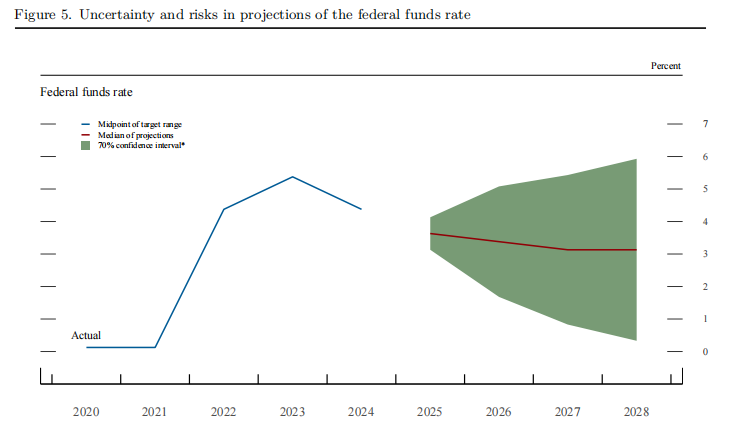
The median path for the federal funds rate shows it at 3.6% by the end of 2025, 3.4% by the end of 2026, and a long-term neutral rate of 3.0%. Members emphasized that future policy steps will be data-dependent without a preset course, and the central bank will move forward with its balance sheet reduction plan.
Overall Expectation of Gradual and Slow Rate Cuts
III. Policy Discussions and Risk Management
Monetary Policy Stance: Shifting from Restrictive to Neutral
The vast majority of members backed this rate cut, viewing it as a response to rising downside risks to employment alongside the fact that inflation risks had not worsened further. The minutes explicitly stated that monetary policy is not on a fixed path and will be flexibly adjusted based on incoming data.
Balancing Risks: Employment vs. Inflation
Members widely recognized that current policy faces a two-way risk: cutting rates too quickly could drive up inflation expectations, while maintaining high interest rates for too long could worsen the labor market. The meeting emphasized the need to strike a fine balance between promoting employment and maintaining price stability.
Financial Markets and Liquidity Conditions
Financial markets performed steadily during the intermeeting period, with stock markets trading near all-time highs and corporate bond spreads remaining narrow. Although overnight financing rates experienced some volatility around tax payment deadlines and Treasury issuances, overall liquidity remained ample and the system operated smoothly.
Conclusion
The Fed's September meeting officially launched the rate-cut cycle, reflecting that the goal of stabilizing the labor market is carrying noticeably more weight in policy considerations. Stephen I. Miran's dissenting vote highlights the internal debate over the appropriate pace of easing. Moving forward, monetary policy will be heavily data-dependent, specifically leaning on the actual impacts of employment, inflation, and tariff policies. As the rate path gradually shifts lower, the Fed will continue its search for balance amid ongoing uncertainties.